While global demand for freeze-dried foods explodes, Indian farmers continue struggling with age-old challenges. Crops rot in storage due to inadequate cold chains. Middlemen eat into already thin profit margins. Price volatility makes planning impossible. Export opportunities remain out of reach for small and medium farmers who lack the infrastructure, certifications, and connections to tap into lucrative international markets. Meanwhile, countries worldwide are desperately seeking reliable suppliers of high-quality freeze-dried vegetables, fruits, and herbs.
Every season, millions of tons of perfectly good produce goes to waste across India. Farmers watch helplessly as bumper harvests crash market prices, leaving them with losses despite abundant yields. At the same time, freeze dried food manufacturers in India struggle to source consistent, quality raw materials at scale. International buyers pay premium prices for freeze-dried products but can't find enough reliable Indian suppliers meeting their quality and volume requirements. This disconnect costs everyone—farmers lose income, manufacturers miss growth opportunities, and India loses its chance to dominate a booming global industry.
A revolution is quietly unfolding across Indian agricultural regions. Progressive farmers, innovative freeze-drying facilities, and forward-thinking export companies are creating new supply chains that connect rural farms directly to international supermarkets. This isn't just another agricultural trend—it's a fundamental transformation that's lifting farmer incomes, reducing food waste, creating rural employment, and positioning India as a global freeze-dried food powerhouse. The model works, it scales, and it's replicable across regions and crops.
Why the World Wants Indian Freeze-Dried Products?
India possesses unique advantages that make it ideal for freeze-dried food production. The diversity of agro-climatic zones allows year-round cultivation of different crops. Labor costs remain competitive compared to developed nations. Traditional agricultural knowledge combines with modern farming techniques to produce exceptional quality.
Global consumers are driving unprecedented demand for freeze-dried foods. Health-conscious buyers want convenient, nutritious options without preservatives or artificial ingredients. Camping and outdoor recreation industries need lightweight, long-lasting food supplies. Emergency preparedness markets require shelf-stable nutrition. Space agencies, military organizations, and disaster relief operations all depend on freeze-dried provisions.
Products like freeze dried kale command premium prices in Western markets where health trends drive consumption. Superfoods, organic vegetables, and exotic Indian herbs fetch extraordinary margins when properly processed and exported. Freeze dried sweet corn serves multiple markets—from ready-to-eat snacks to ingredients for soups, camping meals, and pet foods.
The numbers tell the story. The global freeze-dried food market is projected to exceed $106.6 billion by 2028, growing at over 7.4% annually. India currently captures only a small fraction of this market despite having the agricultural capacity to supply far more. This represents an enormous untapped opportunity.
From Paddy Fields to International Shelves: The New Supply Chain
Traditional agricultural supply chains trap farmers in cycles of low returns and uncertainty. The new freeze-dried export model changes everything by creating direct connections between farms and end markets.
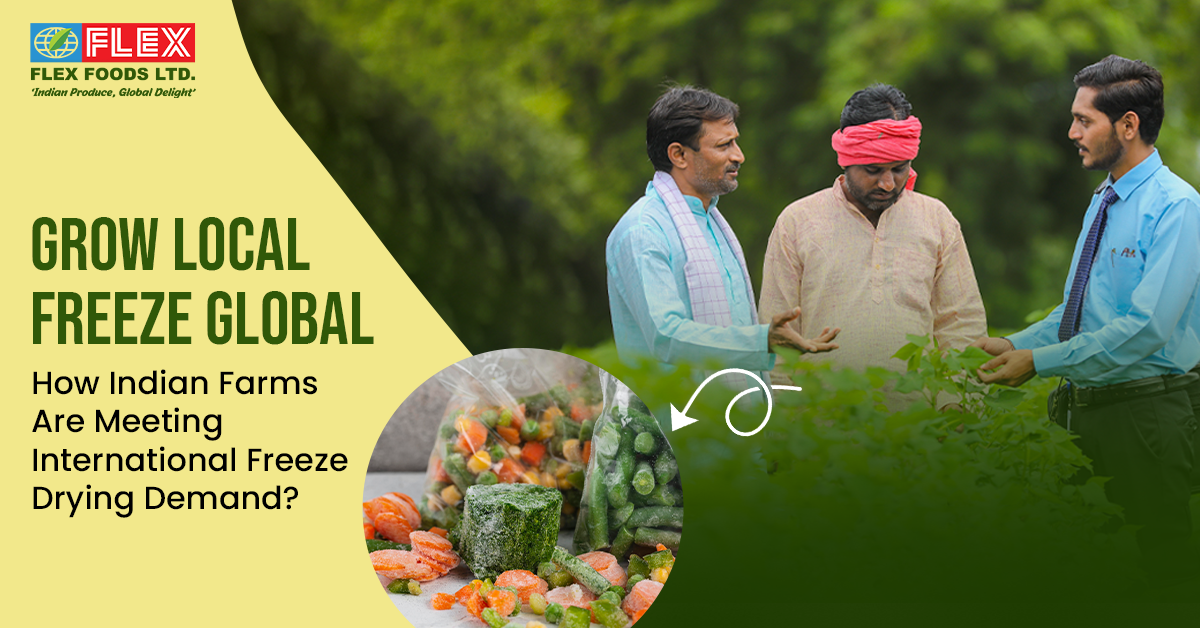
Contract farming arrangements provide stability. Freeze-drying companies sign agreements with farmer cooperatives, guaranteeing purchase quantities and prices before planting even begins. Farmers know exactly what to grow, how much, and what they'll earn. This eliminates the price uncertainty that traditionally plagues agriculture.
Quality specifications get communicated upfront. International buyers demand specific standards for pesticide residues, appearance, size, and freshness. Farmers receive training on cultivation practices that meet these requirements. Agricultural extension services provided by freeze-drying companies help farmers optimize yields while maintaining quality.
Harvest logistics are streamlined. Instead of selling to local mandis where produce sits for days losing freshness, contracted farmers deliver directly to freeze-drying facilities within hours of harvest. This preserves nutritional content and ensures superior final product quality.
Processing happens close to farms. Progressive freeze-drying companies establish facilities in agricultural regions rather than distant industrial zones. This reduces transportation time and costs while creating rural employment opportunities that keep young people from migrating to cities.
Export documentation and compliance are handled by specialized teams. Farmers don't need to understand international regulations, certificates of origin, or phytosanitary requirements. The freeze-drying companies and export partners manage all complexities, allowing farmers to focus on growing exceptional crops.
Recommended Read : Freeze-Dried vs. Dehydrated Vegetables
Technology Bridging the Farm-to-Facility Gap
Digital technologies are solving traditional coordination problems that kept small farmers out of export markets.
Mobile applications connect farmers directly to freeze-drying companies. Farmers photograph their ready-to-harvest crops and upload through simple apps. Quality assessment happens remotely using image analysis. Harvest schedules coordinate automatically, with farmers receiving pickup time slots that minimize field-to-facility delays.
Traceability systems track every batch from specific farms. QR codes on final products allow international consumers to see exactly which farm grew their food, when it was harvested, and how it was processed. This transparency commands premium pricing and builds consumer trust.
Payment systems deliver funds directly to farmer bank accounts within days rather than weeks or months typical in traditional supply chains. Digital payments eliminate middlemen and ensure farmers receive full agreed prices without deductions.
Weather forecasting and agricultural advisory services provided through farmer apps help optimize cultivation. Farmers receive alerts about optimal planting times, pest management, irrigation schedules, and harvest windows. This support significantly improves yields and quality.
Its sensors in storage facilities ensure proper conditions before processing. Temperature and humidity monitoring protects produce quality between harvest and freeze-drying. Farmers see real-time data showing their crops are handled properly, building confidence in the supply chain.
Also Read : Top Trends for Freeze-Dried Food
Economic Impact Transforming Rural Communities
The freeze-dried export boom creates benefits far beyond individual farmer incomes.
Rural employment multiplies. Freeze-drying facilities require workers for sorting, cleaning, quality control, packaging, and maintenance. Each facility creates 50-200 jobs in rural areas where alternatives are limited. Women particularly benefit from these opportunities, with many facilities employing predominantly female workforces.
Ancillary businesses emerge around freeze-drying hubs. Transportation services, packaging material suppliers, equipment maintenance providers, and food safety testing laboratories all establish operations near processing centers. This economic clustering creates comprehensive rural development.
Agricultural productivity improves across entire regions. When some farmers demonstrate success with quality-focused, contract-based cultivation, neighbors take notice. Best practices spread organically as farmers share knowledge. Even those not directly involved in freeze-dried supply chains benefit from improved techniques and crop diversification ideas.
Land values increase in regions connected to freeze-dried export networks. Reliable income streams and reduced market risk make farming more attractive and financially viable. This reverses rural land abandonment trends and encourages continued agricultural investment.
Youth retention in farming improves dramatically. Young people see farming not as a subsistence struggle but as a profitable enterprise with technology integration and global connections. The stereotype of farming as a last resort dissolves when incomes rival or exceed urban employment.
Challenges That Still Need Solving
Despite remarkable progress, significant obstacles remain before India fully captures its freeze-dried export potential.
Capital requirements for freeze-drying equipment remain substantial. A commercial facility requires investments of several crores, putting it beyond reach of individual farmers or small cooperatives. Government subsidies, low-interest agricultural loans, and public-private partnerships need expansion to accelerate facility development.
Quality consistency across millions of small farms presents ongoing challenges. While large contract farms maintain uniform standards easily, aggregating production from thousands of smallholders requires extensive coordination and quality control systems. Continued investment in farmer training and technology-enabled monitoring is essential.
Certification costs and complexity discourage many potential exporters. Organic certification, FSSC 22000, HACCP, and various country-specific certifications require time, expertise, and money. Streamlined certification processes and government support for compliance costs would enable more players to enter export markets.
Power supply reliability affects freeze-drying operations. The process requires continuous electricity for extended periods. Regions with frequent power cuts struggle to maintain production schedules and quality standards. Investment in reliable power infrastructure or backup systems is necessary for consistent operations.
International market access requires sophisticated distribution networks. Getting products into foreign retail chains involves complex negotiations, logistics arrangements, and relationship building that many Indian companies lack experience with. Government trade missions, export promotion councils, and private sector partnerships need strengthening to open more distribution channels.
The Road Ahead: Scaling Success Nationally
India can realistically become the world's leading freeze-dried food supplier
Cluster development should be prioritized. Rather than scattering resources thinly, concentrate investments in regions with ideal growing conditions, farmer organization, and existing infrastructure. Build comprehensive ecosystems where multiple freeze-drying facilities, service providers, and farmers create critical mass.
Research and development into crop varieties optimized for freeze-drying would deliver significant benefits. Not all vegetable or fruit varieties freeze-dry equally well. Breeding programs focused on characteristics like texture retention, color stability, and nutritional content after processing would enhance product quality and market acceptance.
Skill development programs training agricultural graduates in freeze-drying technology, quality management, and export operations would address human capital gaps. These specialized professionals can staff growing facilities and support farmer cooperatives with technical expertise.
Financing innovations like crop-specific loans tied to off-take agreements reduce farmer risk. When banks provide credit based on guaranteed purchase contracts rather than traditional collateral, more farmers can invest in quality inputs and infrastructure improvements.
Trade agreements prioritizing agricultural exports should specifically address freeze-dried products. Reducing tariffs, simplifying customs procedures, and gaining preferential access to major markets would accelerate growth.
Your Role in This Agricultural Revolution
Whether you're a farmer, entrepreneur, investor, or policymaker, opportunities abound in India's freeze-dried export transformation.
Farmers should explore contract cultivation opportunities with established freeze-drying companies. Join or form cooperatives to increase negotiating power and access support services. Invest in learning quality-focused cultivation practices that meet international standards.
Entrepreneurs can establish processing facilities in underserved agricultural regions or create businesses supporting the ecosystem—logistics, packaging, quality testing, or export facilitation all offer viable opportunities.
Investors will find attractive returns in freeze-drying ventures serving export markets. The combination of growing global demand, India's agricultural capacity, and improving rural infrastructure creates compelling investment cases.
Policymakers can accelerate growth through targeted interventions—subsidizing equipment costs, streamlining certifications, improving rural infrastructure, and facilitating international market access all multiply the impact of private sector investments.
Growing Prosperity from Indian Soil
The transformation of Indian agriculture through freeze-dried exports represents more than commercial opportunity. It's about recognizing and realizing the inherent value in Indian farms and farmers. For too long, agricultural produce was treated as a low-value commodity. Freeze-drying captures and preserves the nutrition, flavor, and quality that Indian farms produce, delivering it to consumers worldwide who pay what it's truly worth.
This revolution grows from Indian soil but reaches global markets. It honors traditional agricultural knowledge while embracing modern technology. It creates prosperity in rural areas while satisfying urban and international consumers. It proves Indian agriculture can compete and excel in the most demanding markets.
The opportunity is here. The models are proven. The markets are waiting. Now it's time to scale this success across India, transforming millions more farms and lifting countless rural communities. Grow local, freeze global—this isn't just a catchy phrase. It's the future of Indian agriculture.
Contact Flex Foods to know more about profitable distribution setups.
Frequently Asked Questions
Q1. Will freeze-drying companies actually buy my crops, or will they back out when harvest comes?
Reputable companies use legally binding contracts specifying quantities, quality parameters, and guaranteed prices. Many provide advance payments as commitment proof. Start with established firms having verifiable track records with other farmers. Legitimate companies desperately need consistent supply for their international commitments. Once you prove quality reliability, they actively retain you because finding and training new suppliers costs significantly more than maintaining existing relationships.
Q2. What if my crops don't meet their quality standards and they reject everything?
Companies provide detailed cultivation protocols before planting and conduct regular field visits to identify issues early. Quality parameters are clearly defined—pesticide limits, size specifications, freshness standards. Following their guidelines typically ensures acceptance. Rejections are usually partial, not complete. Most contracts specify alternative pricing tiers for off-grade produce rather than total rejection. Technical support staff guide you throughout the growing season to prevent quality problems.
Q3. I've never exported anything—how will I handle all the paperwork and certifications?
You handle zero export paperwork. Your responsibility ends at delivering quality produce to their facility. The freeze-drying company manages all certifications, export documentation, customs clearance, international shipping, and foreign compliance. You focus exclusively on cultivation. This division of labor makes the model work. Any minimal documentation you need is handled by cooperative representatives or company field staff who guide you completely.
Q4. What happens if the freeze-drying facility closes or the international market changes?
Contracts typically span single seasons, providing flexibility to switch partners if needed. Most companies serve multiple international markets, so problems in one country don't devastate operations. The global freeze-dried market shows consistent growth, reducing demand risk. Skills you learn—quality cultivation, documentation, timing—transfer easily to other buyers. Once connected to quality-focused supply chains, you'll find multiple companies interested in sourcing from proven suppliers.