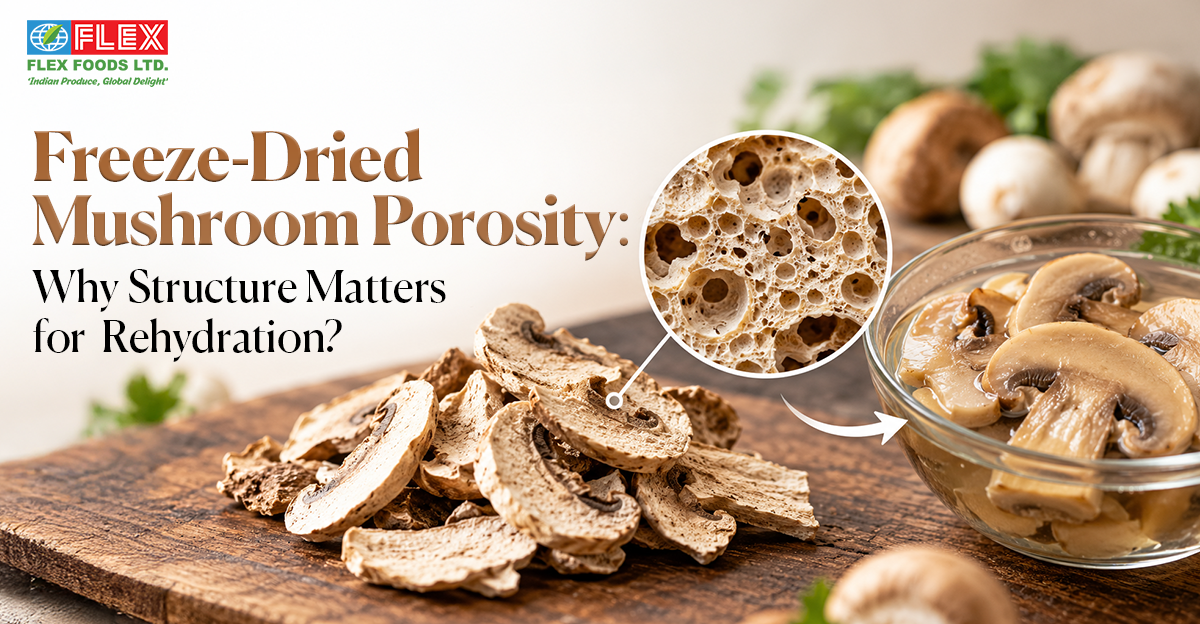
Porosity plays a major role in the quality of freeze-dried mushrooms. It determines how easily water enters the dried tissue during rehydration and influences the product's texture, volume recovery, and overall performance. An open, interconnected pore network can support rapid water absorption, while collapsed pores or structural damage may limit hydration.
Freeze-drying preserves food by freezing the material and removing ice through sublimation under controlled vacuum conditions. As the ice disappears, it leaves spaces within the tissue. These spaces form a porous structure that can help water move through the product when it is rehydrated.
However, high porosity alone does not guarantee better results. Pore connectivity, cell-wall integrity, mushroom species, and processing conditions also affect water absorption and texture.
For freeze-dried food in India, understanding these relationships is important when developing ingredients for instant soups, ready-to-eat meals, sauces, and other convenience foods. Consistent processing and reliable quality testing help manufacturers achieve the desired rehydration performance across production batches.
Learn more about the halal certification
What Is Porosity in Freeze-Dried Mushrooms?
Porosity refers to the proportion of a material's volume occupied by pores or empty spaces. In freeze-dried mushrooms, these spaces develop as ice is removed from the frozen tissue during drying.
Mushrooms naturally contain complex cellular structures. Freezing and subsequent sublimation alter this structure, leaving voids that can create pathways for water to enter the dried material.
Open Pores vs. Closed Pores
Open pores connect to the surface or other pores, allowing water to enter under suitable conditions. Closed pores are isolated spaces that do not provide a continuous pathway for water movement.
The distinction matters because water must access the internal structure to rehydrate the mushroom effectively. A product may have many pores but still absorb water slowly if those pores are poorly connected.
Total Porosity vs. Pore Connectivity
Total porosity describes the overall proportion of pore space within a material. Pore connectivity describes how those spaces link together.
Both characteristics influence rehydration. An interconnected network can allow water to penetrate the dried tissue more easily, while restricted pathways may slow absorption.
Other important factors include pore size, pore distribution, surface accessibility, and the condition of the mushroom's cellular structure.
Manufacturers should therefore evaluate the complete pore network rather than treating total porosity as the only indicator of quality.
Read more about the dehydrated vegetables
How Does Porosity Affect the Rehydration of Freeze-Dried Mushrooms?
Rehydration is the process through which a dried ingredient like freeze-dried fruits and mushrooms absorbs water and recovers some of its original moisture, volume, and texture. Porosity influences this process in several ways.
1. Water Absorption Rate
An accessible pore network creates pathways through which water can enter dried mushroom tissue. This can support faster initial hydration than in a dense structure where shrinkage restricts water movement.
The absorption rate also depends on the mushroom species, piece size, water temperature, and rehydration method.
2. Rehydration Ratio
The rehydration ratio compares the mass of a hydrated sample with its original dry mass. It provides a useful measure of water uptake when testing conditions remain consistent.
A porous structure can support water absorption, but the final ratio also depends on tissue composition, structural integrity, and the amount of water retained after draining.
3. Volume Recovery
Freeze-dried mushrooms may recover some of their original volume when water enters the pores. The extent of recovery depends on whether the cellular structure can retain its shape during hydration.
Excessive shrinkage or structural damage during processing may limit volume recovery even when the product absorbs water.
4. Texture and Firmness
Texture depends on the relationship between water absorption and the strength of the remaining tissue structure. A mushroom that absorbs water quickly may still become too soft or lose its integrity if its cellular structure has been damaged.
Manufacturers should evaluate firmness, elasticity, and structural integrity alongside water uptake.
5. Water Retention and Juiciness
Absorbing water and retaining water are different properties. A product may take up substantial water during rehydration but lose some of it during draining or subsequent cooking.
Structural integrity and the loss of soluble solids can influence the final eating quality. Testing several parameters together provides a more complete assessment of performance.
Research comparing freeze-dried and conventionally dried porcini mushrooms has reported differences in water absorption, equilibrium moisture, texture, and microstructure. However, results depend on the species and experimental conditions, so they should not be treated as universal performance guarantees.
How Freeze-Drying Creates a Porous Mushroom Structure?
The freeze-drying process involves freezing, primary drying, and secondary drying. Each stage contributes to the structure and quality of the finished ingredient.
Step 1: Freezing and Ice-Crystal Formation
Mushrooms are frozen before drying. Ice crystals form within the tissue, and their size and distribution depend partly on freezing conditions.
These ice crystals influence the spaces left behind during sublimation. Differences in freezing conditions can therefore affect the final pore structure and subsequent water movement.
Step 2: Primary Drying and Sublimation
During primary drying, pressure is reduced and controlled heat is supplied to remove ice through sublimation. Sublimation converts ice directly into water vapour without passing through the liquid phase.
As the ice disappears, it leaves voids within the tissue. These voids contribute to the porous structure of the dried mushroom.
Step 3: Secondary Drying
After most of the ice has been removed, secondary drying reduces the remaining moisture through desorption.
This stage helps achieve the required residual moisture level. The process must be controlled to maintain product quality and avoid undesirable structural changes.
Step 4: Formation of the Final Pore Network
The finished structure reflects several interacting factors:
- Total porosity and pore distribution.
- Connectivity between pores.
- Cell-wall integrity.
- Tissue shrinkage and collapse.
- Residual moisture.
- Mushroom variety and slice thickness.
Freeze-drying creates porosity by removing ice from frozen tissue. However, the resulting structure depends on the raw material and processing conditions. Manufacturers must optimize the complete cycle to achieve the desired rehydration performance.
Key Factors That Influence Porosity in Freeze-Dried Mushrooms
1. Freezing Rate and Ice-Crystal Size
Freezing rate influences ice-crystal formation and distribution. These characteristics affect the structure left after sublimation.
There is no single freezing rate that is optimal for every mushroom variety or product format. Manufacturers must evaluate the results for their specific process.
2. Mushroom Species and Composition
Button, shiitake, oyster, and porcini mushrooms differ in tissue structure, composition, and cell-wall characteristics. These differences can influence freezing, drying, water absorption, and texture.
Processing conditions should account for these variations rather than assuming that all mushrooms will behave identically.
3. Slice Thickness and Product Geometry
Slice thickness influences heat transfer and moisture movement during drying. Thick and thin pieces may require different processing times to achieve similar moisture levels.
Uniform cutting helps reduce variations in drying performance and improves batch consistency.
4. Primary and Secondary Drying Conditions
Shelf temperature, chamber pressure, product temperature, drying duration, and residual moisture all influence the final structure.
These parameters must be optimized together. Changing one condition without considering the others can affect product quality and process efficiency.
5. Structural Shrinkage and Cell-Wall Integrity
Excessive shrinkage can restrict the pathways through which water enters the dried tissue. Cell-wall damage can also influence water retention, texture, and the loss of solids during rehydration.
Research on shiitake mushrooms has examined how freezing conditions affect pore structure and hydration properties. Such findings highlight the need to balance pore formation with the preservation of tissue integrity.
Recommended Read : does freeze drying food remove nutrients
Common Problems That Reduce Mushroom Rehydration Quality
Several processing and testing issues can reduce rehydration performance:
- Excessive shrinkage during drying.
- Poorly connected pores.
- Structural damage caused by unsuitable freezing conditions.
- Inconsistent slice thickness.
- Non-uniform drying.
- Inadequate control of primary or secondary drying.
- Unsuitable rehydration conditions.
- Excessive loss of soluble solids.
- Inconsistent testing procedures.
- Evaluating water absorption without checking texture or volume recovery.
Manufacturers should investigate these problems using process records, laboratory measurements, and root-cause analysis. Corrective actions should address the source of the deviation rather than only its visible effects.
Read more : thaw vs defrost
Industrial Applications of Freeze-Dried Mushrooms
Freeze-dried mushrooms are used in several food applications where lightweight ingredients, storage stability, flavour, and rehydration performance may be important.
Freeze-Dried Mushrooms for Instant Soups
Predictable hydration helps mushrooms achieve the intended texture during soup preparation. Piece size and rehydration time should match the formulation.
Freeze-Dried Mushrooms for Ready-to-Eat Meals
Manufacturers must consider how the ingredient behaves during preparation, including water absorption, texture, and its interaction with other ingredients.
Freeze-Dried Mushrooms for Sauces and Seasonings
Mushrooms may contribute flavour and texture to sauces, seasoning blends, and other formulations. The required particle size and hydration characteristics depend on the application.
Freeze-Dried Mushrooms for Convenience Foods
Freeze-dried ingredients like freeze-dried sweet corn and mushrooms may be suitable for products where low weight, convenient storage, and specific textural characteristics are valuable.
Quality Considerations for Food Manufacturers
Ingredient buyers should assess rehydration performance, texture, moisture stability, microbiological quality, packaging, and suitability for the intended formulation. Suppliers should provide clear product specifications and relevant quality documentation to support purchasing decisions.
Conclusion
Porosity is an important factor in the rehydration quality of freeze-dried mushrooms. An accessible pore network can help water enter the tissue, but the final outcome also depends on pore connectivity, cell-wall integrity, drying conditions, and the rehydration method.
Food manufacturers can improve consistency by optimizing freezing and drying cycles, maintaining uniform product dimensions, and monitoring relevant quality parameters. Tests for water absorption, volume recovery, texture, and dry-matter loss provide a more complete picture than porosity measurements alone.
For ingredient suppliers and food manufacturers, understanding these structural characteristics supports better product development, more predictable processing, and improved suitability for commercial food applications.
Frequently Asked Questions
1. Why Is Porosity Important in Freeze-Dried Mushrooms?
Porosity influences how water enters dried mushroom tissue during rehydration. An accessible, interconnected pore network can support rapid water absorption, while pore collapse and structural damage can affect hydration and texture.
2. Why Do Freeze-Dried Mushrooms Rehydrate Quickly?
Freeze-dried mushrooms often have an open structure formed when ice is removed through sublimation. This structure can provide pathways for water to enter the product, although the actual rate depends on species, pore connectivity, and processing conditions.
3. What Is the Difference Between Open and Closed Pores?
Open pores connect with the surface or other pores, allowing water to enter under suitable conditions. Closed pores are isolated spaces that do not provide continuous pathways for water movement.
4. How Does Freeze-Drying Affect Mushroom Structure?
Freeze-drying removes frozen water through sublimation, leaving voids that contribute to porosity. The final structure depends on freezing conditions, mushroom characteristics, and drying parameters.
5. How Is the Rehydration Ratio Calculated?
The rehydration ratio is calculated by dividing the mass of the rehydrated sample by its original dry mass. Consistent hydration, draining, and weighing procedures are necessary for meaningful comparisons.