Freeze-dried fruits and vegetables are lightweight, shelf-stable ingredients that can be used in ready-to-eat and convenience foods. The freeze-drying process removes water through sublimation under vacuum, helping preserve characteristics such as colour, shape, flavour and rehydration performance. Food manufacturers use them in ready meals, instant soups, noodles, snacks, cereals, bakery products, beverages and meal kits.
Why Are Freeze-Dried Fruits and Vegetables Used in Ready-to-Eat Foods?
The ready-to-eat food industry depends on ingredients that offer convenience without creating unnecessary storage and handling challenges. Freeze-dried fruits and vegetables fit this requirement because the process removes most of the moisture while maintaining the physical structure of the ingredient.
Longer Shelf Stability
Freeze-drying significantly reduces the moisture available in fruits and vegetables. When the product is properly processed, packaged and stored, its low moisture content can support a long shelf life.
This makes freeze-dried ingredients useful for food products that need to remain stable during storage and distribution. The actual shelf life depends on factors such as water activity, packaging, processing conditions and storage temperature.
Lightweight Ingredients
Fresh fruits and vegetables contain substantial amounts of water. Removing this water reduces the weight of the finished ingredient, which can make handling, transportation and storage more convenient.
For manufacturers producing packaged foods, lightweight ingredients can also simplify ingredient management. The reduced weight can be particularly useful for products intended for distribution over long distances.
Convenient Storage
Unlike fresh produce, freeze-dried ingredients do not generally require frozen storage when they are properly packaged and the finished product is designed for ambient storage. This can simplify inventory planning for manufacturers.
However, storage conditions remain important. Exposure to humidity can cause freeze-dried ingredients to absorb moisture and lose desirable characteristics.
Rehydration
Freeze-drying creates a porous structure in many fruits and vegetables. This structure allows water to enter the product during rehydration.
The speed and quality of rehydration depend on factors such as particle size, product structure, processing conditions, water temperature and the amount of available water.
Colour, Shape and Flavour
Freeze-drying can help retain several characteristics of the original ingredient. Properly controlled processing can support the retention of colour, shape and flavour, although results vary according to the raw material and processing conditions.
For ready-to-eat products, this can help manufacturers create foods with recognisable fruit and vegetable pieces.
Year-Round Ingredient Availability
Seasonal produce can create challenges for manufacturers that need a consistent supply throughout the year. Processing fruits and vegetables into shelf-stable ingredients can help manufacturers plan production beyond the fresh harvest period.
This does not eliminate agricultural or supply-chain variability, but it can provide another way to manage seasonal ingredients.
Reduced Dependence on Cold Chain
Finished freeze-dried products can often be stored without frozen transportation when their specifications and packaging support ambient storage. This can provide logistical flexibility compared with ingredients that must remain frozen.
The appropriate distribution model should always be determined by the product's water activity, packaging, shelf-life requirements and storage specifications.
Learn more about the Food Recall and Crisis Management
Applications of Freeze-Dried Fruits and Vegetables in Ready-to-Eat Foods
Freeze-dried ingredients can serve many purposes across the convenience food industry. Their use ranges from whole pieces and slices to powders and ingredient blends.
Ready-to-Eat Meals
Ready meals can use freeze-dried vegetables as convenient ingredient components. Peas, carrots, corn, spinach and other vegetables can be incorporated into rice meals, pasta dishes, curry meals and international food preparations.
The ingredients can be selected according to the desired particle size, formulation and rehydration behaviour. Fruit ingredients can also be used in selected sweet or specialty ready-to-eat formulations.
Instant Noodles
Instant noodles are another important application. Freeze-dried carrots, peas, corn, spring onions, mushrooms and spinach can add colour, flavour and visible vegetable pieces to noodle products.
The porous structure of freeze-dried vegetables can support rehydration when hot water is added. This makes them suitable for products designed for quick preparation.
Instant Soups
Freeze-dried vegetables can be used as pieces, powders or blends in instant soups. Carrots, peas, corn, spinach, onions and other vegetables can be combined with seasonings and other ingredients.
Powders can contribute flavour and formulation characteristics, while vegetable pieces can provide visible texture and variety.
Breakfast Cereals
Freeze-dried fruit pieces are widely suited to cereal applications. Strawberry, banana, mango, apple and berry ingredients can be used as inclusions or toppings.
Their low moisture content can also help manufacturers formulate products where maintaining a crisp cereal texture is important. Packaging still needs to protect the product from moisture.
Granola and Muesli
Granola and muesli products can incorporate freeze-dried fruits to add natural fruit pieces and flavour. Mango, strawberry, banana and berries can work across different formulations.
The ingredient format can be adjusted according to the product, from small pieces to powders.
Snack Products
Freeze-dried fruits and vegetables can be used in fruit snacks, vegetable snacks, trail mixes and ingredient blends. Their lightweight structure makes them practical for products designed for convenience and portability.
Manufacturers can combine different fruits or vegetables to create varied flavour and texture profiles.
Bakery Products
Freeze-dried ingredients can be incorporated into cookies, muffins, cakes, breads and pastries. Fruit pieces and powders can provide flavour and colour without introducing the same level of moisture as fresh fruit.
This can be useful when the manufacturer needs greater control over the formulation.
Dairy and Ice Cream
Freeze-dried fruit pieces can be used as inclusions or toppings in yogurt and ice cream products. Strawberry, mango, banana and other fruits can provide visible pieces and fruit flavour. The choice of ingredient size and formulation depends on the desired eating experience and moisture conditions within the finished product.
Smoothies and Beverage Mixes
Fruit and vegetable powders can be used in smoothie blends, beverage mixes and other dry formulations. Powders are particularly useful when manufacturers need ingredients that disperse or blend into a larger formulation.
Processing specifications should be selected according to the beverage's intended preparation method.
Seasonings and Food Mixes
Onion, garlic, herbs and vegetable powders can be incorporated into seasonings, dry mixes and convenience food formulations.
These ingredients can help manufacturers create consistent flavour profiles while simplifying ingredient storage and handling.
Read more : Button Mushrooms
Which Fruits and Vegetables Can Be Freeze-Dried?
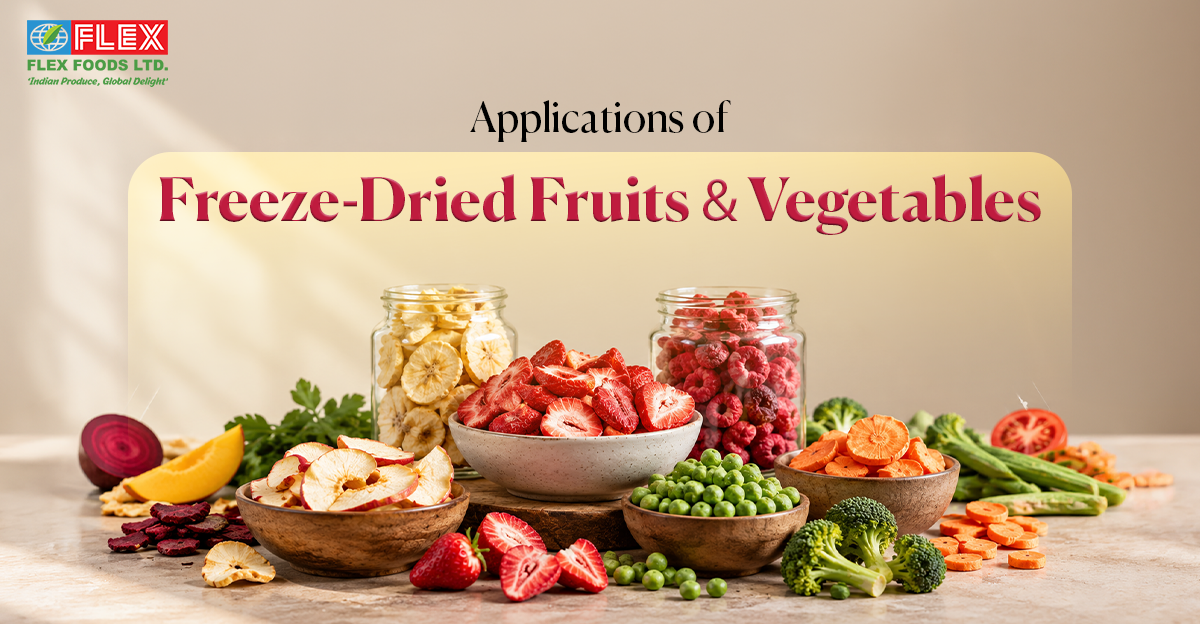
The suitable ingredient range depends on raw material quality, processing capability and the intended application. Common examples include:
| Fruits | Vegetables |
|---|---|
| Strawberry | Green peas |
| Mango | Sweet corn |
| Banana | Carrot |
| Pineapple | Broccoli |
| Apple | Cauliflower |
| Papaya | French beans |
| Chikoo | Spinach |
| Other berries | Potato |
| Other seasonal fruits | Onion |
| Garlic |
A manufacturer's available range should always be checked against its current product portfolio and specifications.
Benefits of Freeze-Dried Ingredients for Food Manufacturers
Freeze-dried ingredients offer several potential advantages for B2B food manufacturers.
Consistent Ingredient Supply
Processed ingredients can support production planning when fresh produce is seasonal or subject to supply fluctuations.
Easier Inventory Management
Dry ingredients can be easier to store and handle than highly perishable fresh produce, provided appropriate packaging and storage conditions are maintained.
Reduced Ingredient Weight
Removing water significantly reduces the weight of fruits and vegetables. This can support efficient transportation and handling.
Convenient Handling
Freeze-dried pieces, powders and blends can be measured and incorporated into food formulations according to product requirements.
Extended Shelf Stability
Low moisture and controlled water activity can support shelf stability when combined with suitable packaging and storage.
Multiple Product Applications
The same type of ingredient may be suitable for different applications, including snacks, cereals, soups, beverages and ready meals.
Product Development Flexibility
Manufacturers can select different particle sizes, cuts, powders and blends depending on the product's formulation and processing requirements.
Potential Reduction in Food Waste
Processing can provide a way to preserve suitable agricultural produce for use beyond the fresh harvest period. However, waste reduction depends on the complete supply chain and production process.
Export and International Food Applications
Lightweight, shelf-stable ingredients can be useful for manufacturers serving international markets. Packaging, regulatory compliance, logistics and destination-country requirements must be considered for export applications.
Freeze-Dried vs Fresh vs Frozen vs Dehydrated Fruits and Vegetables
Different preservation technologies serve different purposes. Food manufacturers should select an ingredient based on its final application rather than assuming one technology is suitable for every product.
| Factor | Freeze-Dried | Fresh | Frozen | Dehydrated |
|---|---|---|---|---|
| Water content | Very low | High | High | Reduced |
| Storage | Generally ambient when properly packaged | Refrigerated | Frozen | Generally ambient |
| Weight | Low | High | High | Reduced |
| Rehydration | Generally fast | Not applicable | Not applicable | Varies |
| Cold chain | Often not required for finished dry product | Usually required | Required | Usually not |
| Texture | Light and porous | Fresh | Frozen | More compact |
| Processing cost | Higher | Low processing | Moderate | Varies |
| Typical applications | RTE, snacks, ingredients | Fresh food | Foodservice and RTE | Soups, mixes and ingredients |
Are Freeze-Dried Ingredients Better Than Dehydrated Ingredients?
There is no universal answer. The appropriate technology depends on the target product, texture, rehydration requirements, cost, shelf-life target, packaging, distribution model and end-use application.
Freeze-drying may be appropriate when manufacturers require a lightweight ingredient with a porous structure and specific rehydration characteristics. Dehydration may be more appropriate where cost, compact texture or other formulation requirements take priority.
Nutritional and Quality Considerations
Does Freeze-Drying Preserve Nutrients?
Freeze-drying can help retain certain nutritional and quality characteristics, but nutrient retention varies. The result depends on the fruit or vegetable, nutrient involved, pretreatment, freezing conditions, drying conditions and storage.
Manufacturers should rely on product-specific nutritional data rather than broad claims about complete nutrient retention.
Does Freeze-Drying Preserve Colour?
Controlled freeze-drying can help retain the natural appearance of many fruits and vegetables. Colour stability depends on the raw material, pretreatment, processing conditions, oxygen exposure and storage.
Does Freeze-Drying Preserve Flavour?
Freeze-dried products can retain much of the characteristic flavour of the original ingredient. However, flavour performance can vary with raw material quality, processing and packaging.
Does Freeze-Drying Preserve Texture?
The process can preserve the physical structure of many fruits and vegetables while creating a lightweight, porous product. The resulting texture differs from fresh produce and can change again after rehydration.
What Happens When Freeze-Dried Vegetables Are Rehydrated?
When water enters the porous structure, the vegetable can regain some of its original characteristics. The final texture depends on the vegetable, cut size, drying process, water temperature and rehydration conditions.
Recommended Read : Food Export Compliance
Rehydration of Freeze-Dried Fruits and Vegetables
Rehydration is an important consideration when selecting ingredients for ready-to-eat products.
How Do You Rehydrate Freeze-Dried Vegetables?
Freeze-dried vegetables can generally be rehydrated by adding water under conditions suitable for the specific product. Manufacturers should follow supplier specifications because the required water quantity and preparation method can vary.
How Do You Rehydrate Freeze-Dried Fruits?
Fruit can be rehydrated using water or incorporated directly into certain formulations, depending on the application. Cereals, bakery products and dairy applications may require different approaches.
How Long Does Rehydration Take?
There is no single rehydration time for every fruit or vegetable. Particle size, structure, processing conditions, water temperature and water availability all influence the rate.
What Factors Affect Rehydration?
Important factors include particle size, porosity, product structure, water temperature, processing conditions and the ratio of water to ingredient. Manufacturers should test rehydration under actual application conditions.
Food Safety Considerations for Freeze-Dried RTE Ingredients
Food safety remains critical when using freeze-dried ingredients in ready-to-eat products.
Does Freeze-Drying Kill Bacteria?
Freeze-drying is primarily a moisture-removal and preservation process and should not automatically be considered a microbial kill step. Microbial safety depends on the complete processing system, including raw material controls, hygienic handling, validated processes, testing and storage.Why Water Activity Matters
Water activity measures how much water is available for microbial and chemical activity. Controlling water activity is important for maintaining the stability and safety of dry food ingredients.
Importance of Hygienic Processing
Raw material quality, sanitation, employee hygiene, equipment controls and environmental conditions all contribute to food safety. Good manufacturing practices should be integrated throughout production.
Microbiological Testing
Manufacturers and suppliers should establish appropriate microbiological specifications based on the ingredient and intended application. Testing requirements can vary according to product type, customer requirements and applicable regulations.
Proper Storage
Freeze-dried products should be stored under conditions that protect them from moisture, heat and other factors that could affect quality.
Moisture-Proof Packaging
Packaging is particularly important because moisture uptake can compromise the stability, texture and quality of freeze-dried ingredients.
Packaging Requirements for Freeze-Dried RTE Ingredients
Packaging should protect the ingredient throughout its intended shelf life and distribution cycle.
Important considerations include:
- Moisture barrier
- Oxygen management
- Hermetic sealing
- Appropriate packaging material
- Light protection where required
- Storage conditions
- Transportation conditions
- Shelf-life validation
Why Moisture Protection Is Critical?
Freeze-dried ingredients have very low moisture levels. If they absorb moisture from the surrounding environment, their texture and stability can change.
Moisture protection is therefore an important part of maintaining product quality from manufacturing through final use.
How Packaging Affects Shelf Life?
he packaging system can influence moisture ingress, oxygen exposure and product stability. Manufacturers should select packaging based on the ingredient's properties, target shelf life, distribution conditions and storage environment.
Why Source Freeze-Dried Fruits and Vegetables from an Indian Manufacturer?
India has a diverse agricultural base that provides access to a broad range of fruits, vegetables and herbs. This creates opportunities for food manufacturers looking for processed agricultural ingredients for domestic and international applications.
Sourcing from an Indian manufacturer can also provide access to local raw materials and processing capabilities. However, buyers should assess every supplier based on product specifications, quality systems, certifications, traceability, capacity and export requirements.
The freeze-dried vegetables in India market serves food manufacturers looking for ingredients suitable for convenience foods, snacks, soups, cereals and other applications. Buyers should focus on technical suitability rather than geography alone when selecting a supplier.
Why Choose Flex Foods for Freeze-Dried Fruits and Vegetables?
Flex Foods Limited offers freeze-dried fruits, vegetables and herbs for B2B food applications. Its product portfolio includes ingredients such as papaya, strawberry, mango, banana, pineapple, chikoo and apple, along with vegetables including sweet corn, green peas, carrot, cauliflower, broccoli, French beans, garlic, spinach and onion.
The company serves food manufacturers looking for processed ingredients across different applications. Its freeze-dried range can support product categories including instant foods, cereals, granolas, soups, salads, seasonings, baked goods, snacks and smoothies.
For manufacturers evaluating suppliers, the focus should remain on product specifications, application suitability, quality consistency, packaging, supply capacity and customer requirements. These factors help determine whether a particular ingredient and supplier fit the intended formulation.
Frequently Asked Questions
What are freeze-dried fruits and vegetables?
Freeze-dried fruits and vegetables produce ingredients processed by freezing and then removing water through sublimation under vacuum. The process produces a lightweight, low-moisture ingredient that can retain characteristics such as shape, colour and flavour. When properly packaged and stored, these ingredients can support long shelf life.
Are freeze-dried fruits suitable for ready-to-eat foods?
Yes, freeze-dried fruits can be used in many ready-to-eat and convenience food products. Applications include breakfast cereals, granola, muesli, snacks, bakery products, yogurt, ice cream and beverage mixes. The appropriate format depends on the product formulation, particle size, moisture conditions and desired eating experience.
Are freeze-dried vegetables suitable for instant meals?
Yes, freeze-dried vegetables can be used in instant noodles, soups, rice meals, pasta dishes and other convenience foods. Their low moisture content and porous structure can make them suitable for products where rapid preparation and rehydration are required. Specific performance depends on the vegetable and processing specifications.
What ready-to-eat foods use freeze-dried vegetables?
Freeze-dried vegetables are used in instant noodles, soups, ready meals, meal kits, seasoning blends, snack products and dry food mixes. Common ingredients include peas, carrots, corn, spinach, onions and mushrooms. Manufacturers select the ingredient according to the product's formulation, preparation method and required rehydration characteristics.
What fruits can be freeze-dried?
Many fruits can be processed through freeze-drying, including strawberry, mango, banana, pineapple, apple, papaya and chikoo. Other fruits and berries may also be suitable depending on their composition and the manufacturer's processing capabilities. Product selection should consider the intended application and required quality specifications.