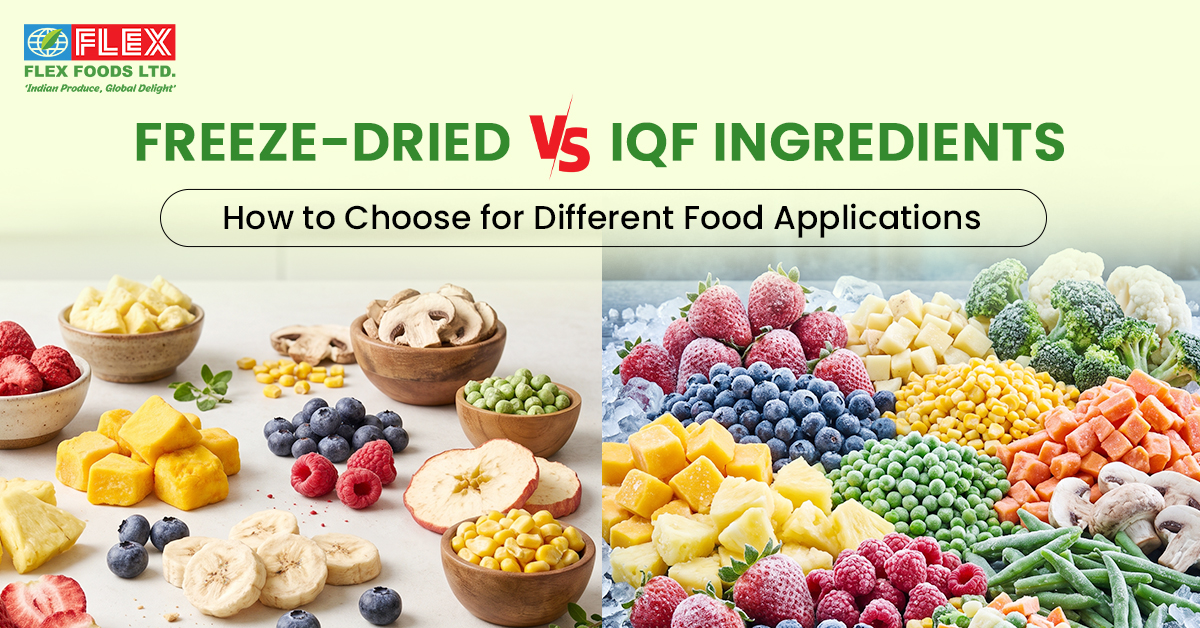
Choosing between freeze-dried and Individually Quick Frozen (IQF) ingredients can influence everything from product quality and shelf life to processing costs and customer experience. Both preservation methods help food manufacturers retain the natural qualities of fruits, vegetables and herbs. However, they serve different purposes and perform differently across food applications.
For manufacturers in the ready-to-eat, snack, seasoning, bakery, dairy and foodservice industries, understanding these differences is essential. While freeze-dried herbs work well in dry seasoning blends and instant meals, IQF herbs often suit applications that need fresh-like flavour, colour, and texture. Similarly, freeze-dried sweet corn offers convenience in dry mixes and snack formulations, whereas IQF sweet corn is a practical choice for soups, curries and prepared meals
So, which preservation method should you choose?
The answer depends on how the ingredient will be used, the moisture requirements of the final product, storage conditions, processing methods and desired shelf life. This guide explores the differences between freeze-dried and IQF ingredients and explains how to select the right option for different food applications
Learn more about the defrosting meaning
What Is Freeze-Drying?
Freeze-drying, also known as lyophilisation, is a food preservation process that removes moisture through sublimation. The process begins by freezing the food at low temperatures. It is then placed in a vacuum chamber, where ice changes directly into water vapour without passing through the liquid stage.
This method removes most of the moisture while helping preserve the ingredient's original structure, colour, flavour and nutritional characteristics
Since freeze-dried ingredients contain very little residual moisture, they are lightweight and have a longer shelf life when packed in moisture-resistant packaging.
Key characteristics of freeze-dried ingredients:
- Low moisture content, which helps limit microbial growth.
- Lightweight structure that makes transportation and storage easier.
- Good retention of natural colour, flavour and aroma.
- Quick rehydration when exposed to water or other liquids.
- Suitable for dry food formulations and products with extended shelf-life requirements.
Where Are Freeze-Dried Ingredients Used?
Freeze-dried ingredients are widely used in food products where moisture control, convenience and flavour retention matter.
Common applications include:
- Instant noodles, soups and meal kits.
- Seasoning blends and spice mixes.
- Breakfast cereals and granola.
- Ready-to-eat meals and camping food.
- Snack products and savoury toppings.
- Bakery mixes and dry food preparations.
For example, freeze-dried herbs can be incorporated into seasoning blends without introducing significant moisture. Similarly, freeze-dried sweet corn can add natural corn flavour and texture to instant soups, snack mixes and dehydrated meal preparations.
What Is IQF Processing?
Individually Quick Frozen (IQF) processing is a freezing technique in which individual pieces of food are rapidly frozen at very low temperatures. Unlike conventional freezing, where ingredients may freeze together into large blocks, IQF keeps individual pieces separate
The process generally involves cleaning, cutting or preparing the raw ingredients before exposing them to a rapid freezing system. Depending on the ingredient and processing requirements, techniques such as fluidised-bed freezing or other rapid freezing systems may be used.
Rapid freezing helps form smaller ice crystals, which can reduce damage to the food's cellular structure. This helps retain the ingredient's shape, texture and quality after thawing.
Key characteristics of IQF ingredients:
- Individual pieces remain separate and easy to portion.
- Fresh-like appearance and texture after proper thawing.
- Natural moisture is retained through freezing.
- Convenient handling for large-scale food production.
- Suitable for applications requiring whole or recognisable ingredients.
Where Are IQF Ingredients Used?
IQF ingredients are commonly used in applications where the original shape, texture and moisture content of the food matter.
Typical applications include:
- Frozen ready meals.
- Soups, stews and curries.
- Pizza and pasta toppings.
- Bakery and confectionery fillings
- Foodservice and catering preparations
- Vegetable mixes and processed foods
For instance, IQF herbs can be added to sauces, marinades and prepared meals where fresh-like herb characteristics are important. IQF sweet corn is also widely suited to vegetable mixes, frozen meals, and savoury preparations
Read more : Is freeze dried fruit healthy?
Freeze-Dried vs IQF Ingredients: Key Differences
Although both methods preserve food, they differ in how they remove or retain moisture. These differences affect ingredient handling, storage, rehydration, texture and suitability for different food products.
Here is a side-by-side comparison to help food manufacturers understand which process best meets their requirements
| Comparison factor | Freeze-Dried Ingredients | IQF Ingredients |
|---|---|---|
| Preservation method | Moisture removal through sublimation | Rapid freezing at low temperatures |
| Moisture content | Very low | Retains natural moisture in frozen form |
| Texture | Lightweight, porous and crisp when dry | Closer to the original texture |
| Weight | Significantly reduced | Similar to the fresh ingredient |
| Shelf life | Generally longer when properly packaged | Requires continuous frozen storage |
| Storage | Cool, dry conditions with moisture protection | Frozen storage |
| Rehydration | Rehydrates when exposed to liquid | Thaws or cooks before use, depending on application |
| Handling | Easy to transport and incorporate into dry mixes | Easy to portion while frozen |
| Flavour | Retains much of the original flavour | Retains fresh-like flavour when properly processed and stored |
| Best suited for | Dry mixes, instant foods and snacks | Frozen meals, sauces and cooked food products |
Freeze-Dried vs IQF: Which Ingredients Work Best?
The choice becomes clearer when we look at individual ingredients. Herbs and sweet corn, for example, have different moisture levels, structures and applications. Their performance can vary depending on the preservation method.
1. Freeze-Dried Herbs vs IQF Herbs
Herbs are used in small quantities, but they have a significant influence on the flavour and aroma of food products. Their delicate structure and volatile aromatic compounds make preservation particularly important.
Freeze-Dried Herbs
Freeze-dried herbs are suitable for products that require concentrated flavour without additional moisture. The process removes water while helping preserve the herbs' natural colour, aroma and flavour.
They are particularly useful for:
- Dry seasoning and spice blends.
- Instant noodles and soup mixes.
- Packaged savoury snacks.
- Ready-to-cook meal kits.
- Bakery seasoning and flavoured crackers.
- Dry marinades and rubs.
For example, freeze-dried parsley, coriander and basil can be incorporated into dry seasoning formulations. Their low moisture content also makes them suitable for products where moisture management is important.
IQF Herbs
IQF herbs retain their natural moisture and are frozen individually for convenient handling. They are a practical choice for food manufacturers that need chopped herbs without the preparation involved in washing, sorting and cutting fresh produce.
Common applications include:
- Frozen sauces and gravies.
- Pasta and pizza toppings.
- Ready-to-cook meals.
- Soups and curries.
- Marinades and dressings.
- Institutional kitchens and foodservice.
IQF coriander, parsley and basil can be added directly to many cooked preparations, depending on the recipe and processing requirements.
Which Should You Choose?
Choose freeze-dried herbs for dry formulations, instant food products and seasoning applications. IQF herbs are better suited to products that require moisture, a fresh-like herb appearance or incorporation into wet preparations.
2. Freeze-Dried Sweet Corn vs IQF Sweet Corn
Sweet corn is a versatile vegetable used in snacks, soups, frozen meals, breakfast products and ready-to-eat foods. Both freeze-drying and IQF processing help manufacturers incorporate sweet corn into different product formulations.
However, the final application determines which option makes more sense.
Freeze-Dried Sweet Corn
Freeze-dried sweet corn is lightweight, has low moisture content and can be rehydrated when required. It offers convenience for manufacturers developing dry food products.
Its common applications include:
- Instant soup and noodle formulations.
- Dehydrated meal kits.
- Savoury snack mixes.
- Breakfast cereals and grain-based products.
- Dry vegetable blends.
- Emergency and outdoor food products.
One of its biggest advantages is that manufacturers can incorporate sweet corn into dry formulations without introducing the moisture associated with fresh or frozen vegetables.
IQF Sweet Corn
IQF sweet corn retains its natural moisture and individual kernel structure. The rapid freezing process helps maintain kernel quality and makes it easier for manufacturers to measure and portion the required quantities.
It is suitable for:
- Frozen vegetable mixes.
- Pizza and pasta toppings.
- Ready-to-eat meals.
- Soups and stews.
- Curries and rice preparations.
- Canned and processed food formulations where the production process permits frozen inputs.
IQF sweet corn is particularly useful when the finished product needs recognisable corn kernels with a juicy bite.
Which Should You Choose?
For instant soups, dry mixes and lightweight meal preparations, freeze-dried sweet corn is a practical option. For frozen meals, vegetable blends and products where kernel texture and moisture matter, IQF sweet corn is generally the better choice.
Choosing Between Freeze-Dried and IQF Ingredients for Different Food Applications
Food manufacturers should evaluate the preservation method based on the requirements of the finished product rather than selecting ingredients based on shelf life alone
Here is how the two options compare across major food categories
1. Instant Foods and Ready-to-Cook Meals
Instant foods need ingredients that can be stored, transported and rehydrated with minimal preparation.
Freeze-dried vegetables, herbs and sweet corn work well in these formulations because they have low moisture content and can absorb water during preparation. Their lightweight structure also helps reduce transportation weight.
IQF ingredients are more appropriate for ready-to-cook meals that are stored frozen and prepared through cooking or reheating.
Recommended choice: Freeze-dried ingredients for dry instant meals and IQF ingredients for frozen ready-to-cook meals.
2. Snacks and Seasoning Products
Snack manufacturers often need ingredients that deliver distinct flavour without affecting the moisture balance of the finished product.
Freeze-dried herbs can be added to seasoning powders, savoury coatings and snack blends. Freeze-dried vegetables can also provide colour, flavour and texture to dry snack formulations.
IQF ingredients are less commonly used directly in dry snack coatings because their moisture content can affect product crispness and stability. However, they can be used in snack fillings and other formulations that involve cooking or further processing.
Recommended choice: Freeze-dried ingredients for dry snacks, seasoning blends and savoury coatings.
3. Soups, Sauces and Gravies
Both preservation methods have a role in soup and sauce manufacturing.
Freeze-dried ingredients are convenient for instant soup mixes, powdered gravies and dehydrated preparations. They rehydrate during cooking and help deliver vegetable and herb flavour.
IQF ingredients are useful for frozen soups, chunky sauces and gravies that require recognisable vegetable pieces. IQF herbs can also be incorporated into wet preparations to provide herb flavour without the need to process fresh leaves.
Recommended choice: Freeze-dried ingredients for dry soup mixes and IQF ingredients for frozen or moisture-rich preparations.
4. Bakery and Confectionery
Bakery manufacturers must consider moisture migration, baking temperatures and the desired appearance of the finished product.
Freeze-dried ingredients can be used in crackers, savoury biscuits, bread mixes and selected confectionery formulations. Their low moisture content makes them easier to incorporate into many dry preparations.
IQF fruits and vegetables may be suitable for fillings and certain baked products, provided the formulation accounts for the moisture released during thawing and baking.
Recommended choice: Freeze-dried ingredients for dry bakery formulations and IQF ingredients for selected fillings and cooked applications.
5. Frozen Ready Meals and Foodservice
Frozen meals require ingredients that maintain their structure and eating quality during storage, thawing and reheating.
IQF vegetables and herbs are particularly useful because manufacturers can portion individual ingredients without thawing an entire block. They also make it easier to standardise recipes across large production batches.
Freeze-dried ingredients can still be used in frozen meal formulations, particularly where they are intended to rehydrate during cooking. However, the manufacturer must account for their water absorption and final texture.
Recommended choice: IQF ingredients for most frozen meal applications, with freeze-dried ingredients used where the formulation benefits from moisture removal
Factors to Consider Before Selecting a Preservation Method
Selecting the right ingredient requires more than comparing processing techniques. Food manufacturers should assess how the ingredient will perform throughout production, storage and consumption.
1. Moisture Requirements
Moisture content is one of the biggest deciding factors. Freeze-dried ingredients have very little residual moisture, making them suitable for dry formulations. IQF ingredients retain natural moisture and are better suited to products that require a fresh-like consistency
2. Texture and Appearance
Consider how the ingredient should look and feel in the finished product. If you need visible vegetable pieces with a defined structure, IQF may be preferable. If the ingredient needs to be lightweight, crisp or easily rehydrated, freeze-drying may be more suitable.
3. Storage and Distribution
Freeze-dried ingredients generally require less demanding storage conditions than frozen ingredients, provided they remain protected from moisture and oxygen.
IQF products need an uninterrupted frozen supply chain. Manufacturers must account for freezer capacity, refrigerated transportation and temperature monitoring.
4. Shelf-Life Requirements
Freeze-dried ingredients generally offer a longer shelf life because their low moisture content limits microbial growth. However, packaging quality, oxygen exposure and storage conditions still influence product stability.
IQF ingredients can also maintain quality over extended periods, but only when stored at the recommended frozen temperature and protected from temperature fluctuations.
5. Rehydration and Processing Time
Freeze-dried ingredients need to absorb moisture before or during preparation. The time required depends on the ingredient size, structure and liquid temperature.
IQF ingredients may be added directly to cooking processes or thawed according to the manufacturer's instructions. This can simplify production where frozen ingredients are already part of the manufacturing workflow.
6. Cost and Production Efficiency
Manufacturers should compare the total cost of using an ingredient rather than looking only at its purchase price.
Freeze-dried ingredients may have a higher purchase cost per kilogram because of the processing involved. However, their reduced weight and storage requirements can offer logistical advantages.
IQF ingredients may have a different cost structure, with additional expenses associated with frozen storage, transportation and cold-chain management
Consider factors such as:
- Cost per usable kilogram.
- Storage and transportation expenses.
- Processing and preparation requirements.
- Ingredient wastage.
- Rehydration yield.
- Production labour and handling costs.
7. Packaging and Product Compatibility
Freeze-dried ingredients need packaging that protects them from moisture absorption. IQF ingredients require packaging suitable for frozen storage and distribution.
Manufacturers should also check ingredient compatibility with the final product's pH, salt content, fat content, processing temperature and intended storage conditions.
Can Freeze-Dried and IQF Ingredients Be Used Together?
Yes. In fact, combining both preservation methods can help manufacturers achieve a balance between convenience, flavour and texture.
A food formulation does not always need to rely on one type of preserved ingredient. The decision depends on the role each ingredient plays in the finished product.
For example, an instant vegetable soup mix could use:
- Freeze-dried sweet corn for natural sweetness and recognisable vegetable pieces
- Freeze-dried herbs for aroma and seasoning.
- IQF vegetables in a separate frozen meal variant where moisture and texture are important.
Similarly, a frozen pasta meal could use IQF vegetables for texture and freeze-dried herbs for additional flavour, provided the formulation and processing conditions support their use.
Using both formats gives product developers greater flexibility when creating formulations for different storage and preparation requirements.
Why Ingredient Selection Matters for Food Manufacturers?
The choice between freeze-dried and IQF ingredients affects several stages of food production.
A manufacturer developing an instant soup mix has different requirements from one producing frozen vegetable meals. Using the wrong ingredient format can affect rehydration, texture, moisture balance, processing efficiency and overall product quality.
For this reason, ingredient selection should begin during product development rather than after the formulation is finalised.
Working with an experienced ingredient supplier can help manufacturers identify suitable formats, evaluate product specifications and maintain consistency across production batches.
At Flex Foods, ingredient quality and processing requirements are important considerations for food manufacturers looking for dependable fruit, vegetable and herb ingredients. Understanding the differences between freeze-dried and IQF formats can help businesses make informed sourcing decisions and develop products that meet their target market's expectations
Frequently Asked Questions (FAQs)
1. What is the main difference between freeze-dried and IQF ingredients?
The main difference is how each process preserves food. Freeze-drying removes moisture through sublimation, producing lightweight ingredients with low moisture content. IQF rapidly freezes individual food pieces while retaining their natural moisture, helping preserve their shape and texture.
2. Are freeze-dried ingredients healthier than IQF ingredients?
Neither method is automatically healthier. Both can preserve many of the original nutritional characteristics of fruits, vegetables and herbs. Nutrient retention varies depending on the ingredient, processing conditions, storage and handling. The nutritional value of the final product also depends on its overall formulation.
3. Can freeze-dried herbs replace fresh herbs?
Yes. Freeze-dried herbs can replace fresh herbs in many applications, particularly dry seasonings, instant soups, marinades and packaged food products. However, manufacturers must adjust the quantity according to flavour intensity, moisture requirements and the intended recipe.
4. What are IQF herbs used for?
IQF herbs are commonly used in soups, sauces, gravies, pasta, marinades, frozen meals and other prepared foods. They provide a convenient alternative to fresh herbs and allow manufacturers to portion individual pieces without handling large frozen blocks.
5. What are the applications of freeze-dried sweet corn?
Freeze-dried sweet corn is suitable for instant soups, noodles, dehydrated meal kits, snack mixes, breakfast cereals and dry vegetable blends. Its low moisture content makes it particularly useful in products that require extended storage without frozen distribution.