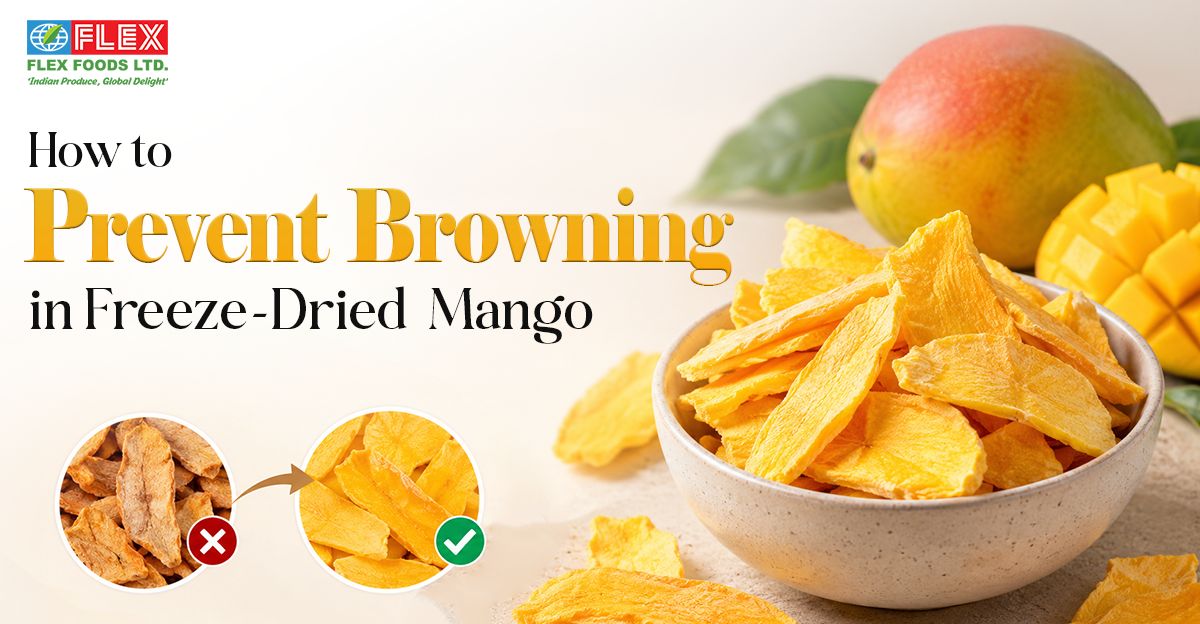
Mangoes are valued for their vibrant yellow-orange colour, naturally sweet flavour, and nutritional properties. However, browning during processing and storage can reduce the visual appeal and perceived quality of freeze-dried mango products. Manufacturers must understand the factors responsible for colour changes to maintain product consistency and meet commercial quality expectations. Effective browning prevention requires coordinated control of raw materials, pretreatment, oxygen exposure, drying conditions, packaging, and storage.
To understand how to prevent browning in freeze-dried mango, manufacturers must first identify the reactions responsible for colour deterioration. Enzymatic browning, non-enzymatic reactions, and oxidation can affect mango tissue at different stages of production. Freeze-drying removes water under vacuum at relatively low product temperatures, helping preserve many of the fruit's original characteristics. However, this process does not automatically eliminate browning, making appropriate pretreatment and process control essential for consistent colour retention.
Learn more about the freeze dried mango exporters with traceability systems
What Causes Browning in Freeze-Dried Mango?
1. Enzymatic Browning
Enzymatic browning occurs when polyphenol oxidase (PPO) reacts with naturally occurring phenolic compounds in the presence of oxygen. These reactions produce intermediate compounds that can subsequently form brown pigments. Peeling, slicing, and other mechanical operations damage mango tissue, bringing enzymes and their substrates into contact with oxygen. Peroxidase (POD), fruit maturity, cultivar, and the composition of the mango can also influence browning susceptibility.
2. Non-Enzymatic Browning
Non-enzymatic browning can occur through chemical reactions that do not depend directly on active browning enzymes. One possible mechanism is the Maillard reaction, which involves reducing sugars and amino compounds under suitable conditions. Oxidative changes involving pigments and other fruit constituents can also contribute to colour deterioration. The extent of these changes depends on factors such as temperature, time, moisture, composition, and storage conditions.
3. Oxygen Exposure During Processing and Storage
Oxygen exposure is an important consideration when mangoes are peeled, sliced, pretreated, and prepared for freezing. Extended handling times can increase opportunities for oxidative reactions to develop before the product enters the freeze-drying process. Oxygen may also enter the finished product through permeable packaging or poorly sealed closures during storage. Reducing unnecessary exposure at each stage helps limit deterioration, although oxygen control alone cannot prevent every browning mechanism.
4. Moisture-Related Colour Changes
Moisture absorption can compromise the quality of freeze-dried mango by changing its physical structure and reducing crispness. Increased moisture can also influence the rate of certain chemical reactions associated with deterioration during storage. However, moisture uptake is not the only cause of browning, and colour changes can occur through other mechanisms. Manufacturers should therefore monitor moisture, water activity, oxygen exposure, and storage conditions together when evaluating product stability.
How to Prevent Browning in Freeze-Dried Mango: Eight Effective Methods
1. Select High-Quality Mangoes at the Appropriate Maturity
Raw-material selection establishes the foundation for consistent colour and quality throughout processing. Manufacturers should select mangoes with suitable ripeness, consistent colour, adequate firmness, and minimal bruising or mechanical damage. Overripe, deteriorated, or visibly damaged fruit should be removed before processing because its quality may be less predictable. Consistent sourcing and cultivar selection also help manufacturers evaluate how effectively a chosen pretreatment performs across production batches.
2. Minimize Oxygen Exposure After Cutting
Freshly cut mango should move through peeling, slicing, pretreatment, and freezing without unnecessary delays. Well-organized processing lines can reduce the time during which exposed fruit surfaces remain in contact with ambient air. Maintaining appropriate product temperatures and following hygienic handling practices also support consistent processing conditions. These measures help control enzymatic oxidation, although additional interventions may be necessary to manage non-enzymatic browning and storage-related deterioration.
3. Apply Suitable Antibrowning Pretreatments
Antibrowning pretreatments can help preserve mango colour before freezing and drying begin. Ascorbic acid acts as an antioxidant that can delay colour changes by reducing oxidation intermediates, while citric acid can lower pH and influence PPO activity. Depending on the product, combining an antioxidant with an acidulant may offer benefits that justify further evaluation. Treatment concentrations, contact times, flavour effects, and applicable food additive requirements should be established through product-specific trials rather than assumed to be universally effective.
4. Evaluate Blanching Carefully
Blanching uses heat to reduce the activity of enzymes associated with enzymatic browning. However, excessive heat exposure can soften mango tissue, alter flavour, affect heat-sensitive nutrients, and change the structure of the final product. These changes may influence the appearance and texture expected from a high-quality freeze-dried ingredient. Manufacturers should evaluate whether thermal pretreatment is appropriate for their particular mango variety and process instead of treating blanching as an essential step in every production line.
5. Optimize Freezing Conditions
Freezing prepares mango tissue for the sublimation stage of freeze-drying by converting its water into ice. Consistent slice thickness and uniform freezing help promote more predictable ice-crystal formation and subsequent moisture removal. Manufacturers should evaluate freezing rate, temperature, loading patterns, and delays between pretreatment and freezing to establish repeatable conditions. Although freezing supports product structure and processing consistency, it does not independently guarantee complete protection against browning.
6. Optimize Primary and Secondary Drying
Primary drying removes ice through sublimation under controlled vacuum conditions. Shelf temperature, chamber pressure, product temperature, and equipment performance must be managed to achieve efficient drying without compromising product structure. Secondary drying removes additional water that remains after the primary stage, helping achieve the required final moisture content and water activity. Validated drying cycles and consistent monitoring are essential because unnecessary thermal exposure or uneven drying may contribute to quality deterioration.
7. Use Appropriate Packaging to Protect Colour
Packaging helps protect dried mango from oxygen, moisture, light, and other environmental factors that can affect product stability. Suitable oxygen- and moisture-barrier materials, reliable seals, and appropriate closures reduce the risk of deterioration during distribution and storage. Nitrogen flushing may further reduce oxygen exposure when the packaging system and process are designed for its use. Packaging cannot reverse browning that has already occurred, so its primary role is to preserve the quality achieved during processing.
8. Maintain Controlled Storage Conditions
Storage conditions influence how well freeze-dried mango retains its colour, texture, flavour, and overall quality. Products should be kept in cool, dry conditions and protected from direct sunlight, excessive humidity, and unnecessary oxygen exposure. Avoiding temperature fluctuations can help reduce condensation risks when products move through storage and distribution environments. Appropriate inventory rotation and periodic quality checks further support consistent product performance throughout the intended storage period.
Read more about the iqf vs freeze dried mango
Which Pretreatments Help Prevent Browning in Freeze-Dried Mango?
Ascorbic Acid Treatment
Ascorbic acid is commonly considered for fruit pretreatment because of its antioxidant properties. It can delay certain oxidative colour changes by reducing intermediate compounds involved in pigment formation. Its effectiveness depends on the mango's characteristics, treatment conditions, and the reactions occurring during processing. Manufacturers should assess colour retention alongside flavour, texture, and storage stability before selecting a suitable formulation.
Citric Acid Treatment
Citric acid can lower the pH of the fruit surface and influence the activity of enzymes associated with browning. This makes it a potential option for managing enzymatic colour changes before freezing. Its effectiveness depends on factors such as concentration, contact time, fruit maturity, and the composition of the treatment solution. Excessive acidification may affect flavour, so the treatment should be evaluated against the product's intended sensory profile.
Combined Treatments and Thermal Pretreatment
Combining an antioxidant such as ascorbic acid with an acidulant such as citric acid may be worth investigating. The potential benefit depends on whether the treatments address the dominant browning mechanism without compromising product quality. Thermal pretreatment can also reduce enzyme activity, but it may affect mango texture, flavour, and heat-sensitive nutrients. Controlled trials should compare these options using colour measurements, browning index, texture, sensory properties, drying performance, and storage stability.
No single pretreatment can be considered the best choice for every mango variety or freeze-drying process. Manufacturers should compare treatments using consistent raw materials, repeatable processing conditions, and suitable control samples. The evaluation should include relevant food additive permissions and labelling requirements for the intended market. A validated formulation should balance colour retention with flavour, texture, nutritional characteristics, and commercial requirements.
How Freeze-Drying Conditions Affect Mango Colour?
Freeze-drying involves freezing the fruit, removing ice through sublimation, and eliminating additional moisture during secondary drying. The freezing stage influences ice-crystal formation and the physical structure of the mango tissue. During primary drying, maintaining suitable product temperatures and chamber pressure supports efficient moisture removal while protecting product integrity. Secondary drying then helps achieve the final moisture and water activity targets required for the intended application.
Process consistency is particularly important when manufacturing commercial quantities of freeze-dried mango. Variations in slice thickness, tray loading, product distribution, and equipment performance can affect drying uniformity. Monitoring and validating process parameters helps manufacturers identify differences between batches before they become persistent quality issues. Although freeze-drying can help preserve the fruit's natural colour, enzyme activity, pretreatment, oxygen exposure, and storage conditions continue to influence the final result.
Enzymatic vs. Non-Enzymatic Browning in Freeze-Dried Mango
Understanding the difference between enzymatic and non-enzymatic browning helps manufacturers select suitable control methods. Enzymatic browning primarily involves PPO-mediated oxidation of phenolic compounds in the presence of oxygen. Non-enzymatic browning includes chemical reactions such as the Maillard reaction and other matrix-dependent colour changes. Because these mechanisms differ, a treatment that reduces enzymatic activity may not prevent every form of colour deterioration.
| Factor | Enzymatic Browning | Non-Enzymatic Browning |
|---|---|---|
| Main mechanism | Enzyme-mediated oxidation of phenolic compounds | Chemical reactions, including Maillard browning and pigment changes |
| Important contributors | PPO, phenolic compounds, and oxygen | Sugars, amino compounds, temperature, time, and matrix composition |
| Control approaches | Antioxidants, acidulants, enzyme inactivation, and oxygen management | Temperature and time control, formulation management, and suitable storage |
| Pretreatment role | Can reduce or delay enzymatic activity | May influence reaction conditions but cannot prevent every reaction |
| Packaging role | Can reduce oxygen exposure | Can help manage oxygen and moisture exposure, depending on the mechanism |
| Testing approach | Colour measurements, browning index, and relevant enzyme tests | Colour measurements and suitable chemical or stability testing |
How to Measure Colour Retention in Freeze-Dried Mango?
Colour measurement allows manufacturers to evaluate whether processing conditions and pretreatments are delivering consistent results. The CIELAB colour system provides three useful parameters for describing product appearance. L* measures lightness, a* represents the green-to-red axis, and b* represents the blue-to-yellow axis. Together, these values provide a more objective basis for assessing colour than visual inspection alone.
Total colour difference, commonly represented by ΔE, helps quantify changes between reference samples and processed or stored products. A suitable browning-index method can provide additional information when it has been validated for the product being evaluated. Measuring PPO activity may also help researchers determine whether a pretreatment has reduced enzymatic browning potential. These measurements should be conducted at defined intervals and interpreted alongside moisture content, water activity, texture, and sensory quality.
For commercial ingredient manufacturers, measurable quality parameters support better process control and more consistent product specifications. Colour testing can help identify whether deterioration develops during pretreatment, drying, packaging, or storage. Comparing batches under controlled conditions also helps research and quality teams investigate the reasons behind unexpected colour changes. This evidence-based approach is particularly valuable when supplying ingredients to food manufacturers with defined appearance and performance requirements.
Recommended Read : thaw meaning in cooking
How Packaging Helps Prevent Browning in Freeze-Dried Mango?
Oxygen and Moisture Barriers
Oxygen-barrier packaging helps limit exposure to oxygen that may contribute to oxidative deterioration. Moisture-barrier materials reduce water vapour transmission and help protect the crisp texture of freeze-dried fruit. Selecting appropriate materials requires consideration of oxygen transmission rate, water vapour transmission rate, package format, and intended storage duration. Reliable sealing is equally important because even high-barrier materials may offer limited protection if the finished package is not properly sealed.
Nitrogen Flushing and Environmental Protection
Nitrogen flushing can replace some of the air inside a package, reducing oxygen exposure when implemented appropriately. Its effectiveness depends on residual oxygen, packaging permeability, seal integrity, and the relevant deterioration mechanisms. Protection from light and suitable storage temperatures can provide additional support for colour and flavour retention. Manufacturers should validate the complete packaging system under representative storage and distribution conditions rather than assuming that a single packaging feature guarantees a specific shelf life.
Common Mistakes That Cause Freeze-Dried Mango to Turn Brown
Several processing errors can undermine colour retention even when the freeze-drying equipment operates correctly. Using overripe or bruised mangoes, leaving cut fruit exposed to air, or delaying freezing can increase the risk of quality deterioration. Unvalidated pretreatment concentrations and excessive heating may also affect colour, flavour, and texture. Inconsistent slice thickness, uneven drying, and unnecessary thermal exposure can create differences between batches.
Packaging and storage mistakes can cause additional problems after the drying process is complete. Inadequate oxygen or moisture barriers, poor seals, high humidity, and temperature fluctuations may accelerate quality deterioration. Checking colour only at the end of production can also allow emerging problems to go unnoticed during storage. A structured quality programme should therefore include process monitoring, finished-product testing, and shelf-life evaluation at defined intervals.
Industrial Applications of Colour-Stable Freeze-Dried Mango
Colour consistency is important for food manufacturers because ingredient appearance contributes to the visual quality of finished products. In breakfast cereals and snacks, bright mango pieces can improve product presentation while providing a distinctive fruit flavour and crisp texture. In bakery applications, ingredient stability and consistent quality are important during storage and incorporation into different formulations. Manufacturers should also assess how moisture and processing conditions in the final product may affect the performance of the fruit ingredient.
In dairy products and desserts, mango colour and flavour can contribute to the overall sensory experience. Ready-to-eat products also benefit from ingredients that maintain consistent appearance and quality throughout their intended storage period. Businesses sourcing Freeze dried Fruits should evaluate colour stability, texture, moisture specifications, packaging, and suitability for the intended formulation. Working with experienced ingredient suppliers can help manufacturers identify appropriate product specifications and establish consistent quality expectations.
For industrial buyers, selecting a supplier involves more than comparing appearance at the point of purchase. Buyers should consider documented specifications, process consistency, packaging suitability, and evidence supporting storage stability. Businesses exploring freeze dried mango for cereals, bakery products, snacks, dairy applications, or desserts should discuss their requirements with the supplier before finalizing product selection. Similar quality-control principles are relevant when evaluating freeze dried vegetables manufacturers in India, particularly where colour, moisture, and consistency are important purchasing criteria.
Conclusion
Preventing browning in freeze-dried mango requires a coordinated approach that begins with raw-material selection and continues through pretreatment, freezing, drying, packaging, and storage. Understanding the differences between enzymatic and non-enzymatic browning helps manufacturers select appropriate interventions without compromising flavour, texture, or nutritional quality. Colour measurements and controlled storage studies provide practical ways to evaluate the effectiveness of these interventions. By combining validated processing methods with suitable packaging and quality assurance, manufacturers can work towards consistent colour retention and dependable ingredient performance.
Frequently Asked Questions
1. Why Does Freeze-Dried Mango Turn Brown?
Freeze-dried mangoes can turn brown because of enzymatic oxidation, non-enzymatic chemical reactions, or oxidative changes during processing and storage. The main cause depends on the fruit's composition, maturity, pretreatment, and processing conditions. Oxygen exposure and moisture uptake may also influence quality deterioration. Identifying the dominant mechanism helps manufacturers select appropriate preventive measures.
2. How Can You Prevent Browning in Freeze-Dried Mango?
Browning can be reduced through suitable raw-fruit selection, prompt processing, validated pretreatments, and controlled freezing and freeze-drying. Ascorbic acid and citric acid are potential pretreatment options that require product-specific evaluation. Oxygen- and moisture-barrier packaging can help preserve quality after drying. Controlled storage and regular colour testing support continued monitoring.
3. Does Freeze-Drying Prevent Browning Completely?
No, freeze-drying does not guarantee complete prevention of browning. Its relatively low product temperatures can help preserve colour and other fruit characteristics. However, enzymatic activity, chemical reactions, oxygen exposure, and storage conditions can still influence colour. Pretreatment and validated process controls remain important.
4. Which Pretreatment Is Best for Preventing Mango Browning?
The most suitable pretreatment depends on the mango variety, maturity, desired flavour, and processing conditions. Ascorbic acid, citric acid, combined treatments, and carefully controlled thermal treatments are potential options. Each approach should be assessed for its effects on colour, texture, flavour, and drying performance. Manufacturers should establish treatment conditions through controlled trials rather than applying a universal formulation.
5. What Causes Enzymatic Browning in Mango?
Enzymatic browning occurs when polyphenol oxidase reacts with phenolic compounds in the presence of oxygen. The resulting intermediates can develop into brown pigments through subsequent reactions. Cutting and peeling can expose fruit tissue and increase contact between these components. Suitable pretreatment and reduced oxygen exposure can help limit this process.
6. Does Packaging Prevent Freeze-Dried Mango from Turning Brown?
Appropriate packaging can reduce some causes of deterioration by limiting oxygen and moisture exposure. Nitrogen flushing may offer additional oxygen control when used with a suitable packaging system. However, packaging cannot reverse browning that has already occurred during processing. Its effectiveness depends on material properties, sealing, and storage conditions.
7. How Do Manufacturers Check Colour Stability?
Manufacturers can use L_a_b* measurements, total colour difference, and suitable browning-index methods to assess colour changes. Enzyme activity testing may provide additional information about enzymatic browning. Evaluations should compare reference samples with processed and stored products under controlled conditions. Moisture, water activity, texture, and sensory quality should also be monitored where relevant.
8. Can Moisture Cause Freeze-Dried Mango to Turn Brown?
Moisture uptake can change the physical structure of freeze-dried mango and influence certain degradation reactions. It may also reduce crispness and affect overall product stability. However, browning can occur independently of moisture uptake through enzymatic or other chemical mechanisms. Effective prevention therefore requires attention to oxygen, temperature, packaging, and the specific causes of colour deterioration.