Global food supply chains have never been more complex. A single frozen vegetable product might involve farms across multiple states, processing units in different cities, and export destinations spanning three continents. Managing all of this without a clear system in place is a risk most manufacturers cannot afford. That is exactly why food traceability has moved from a nice-to-have feature to an operational necessity. Buyers, regulators, and consumers are all asking the same question: where did this product come from, and can you prove it?
For food manufacturers and exporters, the answer to that question determines whether they win contracts or lose certifications. Markets like the United States, European Union, and the Middle East have raised their compliance expectations significantly over the last few years. A single recall mishandled due to poor tracking can cost a brand years of trust-building. Building strong traceability systems is no longer about meeting a checkbox it is about staying competitive in a market that demands full transparency.
Sustainability in Food Processing
What Is Food Traceability?
Definition of Food Traceability
Food traceability is the ability to follow any food product, ingredient, or raw material through every stage of the supply chain from the farm where it was grown to the plate where it is consumed. It works by recording key data at each step: where something came from, how it was processed, when it was packed, and where it went. This data creates a traceable thread through what is often a very complex production and distribution network. Without it, manufacturers are essentially operating blind when something goes wrong.
Understanding "Farm-to-Fork" Traceability
Farm to fork traceability captures the full journey not just production, but sourcing, storage, transport, and delivery. This matters because contamination or quality failure can originate at any point in the chain, not just at the processing stage. Being able to pinpoint the exact batch, supplier lot, or shipment involved saves time, money, and in serious cases lives. It is the foundation on which every modern food safety framework is built.
Why Traceability Is Essential in Modern Food Processing?
Traceability in food processing does several things at once: it protects consumers, protects the business, and satisfies regulatory bodies all through the same set of data. When a quality issue emerges, manufacturers with strong traceability can isolate the problem quickly and avoid pulling entire product lines off shelves unnecessarily. This precision is both cost-efficient and brand-protective. In industries operating on thin margins and high volumes, that kind of control matters enormously.
Beyond crisis management, traceability supports everyday quality assurance. Food manufacturing traceability helps production teams monitor batch consistency, flag deviations early, and trace performance data back to specific supplier lots. It also creates an audit trail that satisfies inspectors and third-party auditors without requiring teams to scramble for records. When traceability is embedded in operations, compliance becomes a byproduct of normal workflow not a separate, stressful exercise.
How Food Traceability Works Across the Supply Chain?
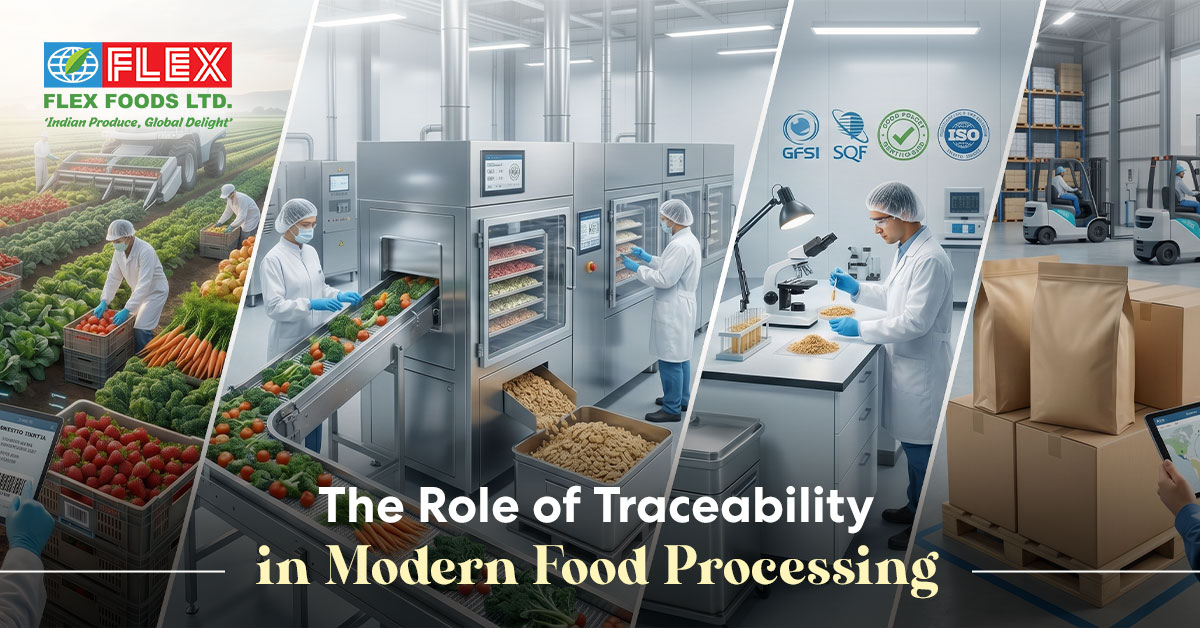
A strong food supply chain traceability system works in stages, each feeding into the next. It begins at raw material sourcing and does not end until the product reaches its final destination. Here is how each stage typically operates:
Stage 1 – Raw Material Sourcing
Farms and agricultural suppliers are verified against standards like GlobalGAP. Supplier approvals, field audits, and origin documentation are collected and stored before procurement begins. This stage sets the quality baseline for everything that follows.
Stage 2 – Ingredient Procurement
Each incoming ingredient is logged against vendor documentation, inspected for quality compliance, and assigned a unique lot identifier. Purchase orders, certificates of analysis, and test reports are linked to this record. Any supplier deviation at this stage is flagged before it enters production.
Stage 3 – Food Processing
Batch production is tracked in real time. Every processing parameter — temperature, time, equipment ID, operator — is recorded and linked to the batch lot. This stage is critical for food safety traceability because it is where most contamination risks either emerge or are eliminated.
Stage 4 – Packaging and Labeling
Finished products receive lot numbers, production dates, and product codes that link them to their complete processing history. Labeling accuracy here is non-negotiable — especially for export. A mismatched label can trigger a hold at customs or a rejection by a retail buyer.
Stage 5 – Distribution and Export
Shipments are tracked from dispatch to delivery. Documentation including certificates of origin, health certificates, and shipping records are linked to the product lot. Food export compliance at this stage depends on how cleanly all previous records have been maintained.
Benefits of Traceability for Food Manufacturers
The operational advantages of a well-run food traceability system are significant. Faster recall execution is the most obvious one — instead of pulling every product from a production window, manufacturers can identify the specific batch affected and limit the scope. This reduces financial loss, minimises waste, and protects consumer relationships. In highly competitive export markets, recall response speed can be the difference between retaining and losing a major buyer.
Beyond recalls, traceability improves inventory visibility and supplier accountability. Manufacturers can spot patterns in raw material quality issues before they escalate into production problems. Product traceability solutions also integrate with ERP and procurement systems, giving operations teams a cleaner view of waste, yield, and supplier performance. Over time, these insights compound into real efficiency gains.
The Connection Between Traceability and Food Safety Certifications
Most global food safety standards now treat traceability as a core requirement, not an optional module. BRC traceability requirements under BRCGS Global Standard mandate that manufacturers demonstrate the ability to trace any raw material or finished product within four hours — a stringent benchmark that demands digital recordkeeping, not manual logs. Auditors test this capability during certification visits, and failure to meet it can result in a failed audit or a downgraded certification grade.
The FSMA food traceability rule, ISO 22000 and HACCP reinforce traceability as a foundational pillar of food safety management. For exporters targeting regulated markets, meeting these certification requirements is inseparable from having a robust traceability infrastructure in place.
Traceability in Frozen and Processed Food Manufacturing
The traceability in the frozen food industry presents some of the most demanding tracking requirements in food manufacturing. Products like frozen vegetables in India, freeze-dried fruits, and air dried herbs in India move through multiple processing stages — cleaning, blanching, freezing or drying, and packing — each of which must be individually documented. Temperature deviations at any point can compromise both quality and safety, making cold chain traceability a critical part of the operation. Without granular batch-level records, manufacturers cannot certify that temperature integrity was maintained throughout.
For exporters of freeze-dried fruits and air-dried herb products, the challenge is even more specific. Moisture levels, drying temperatures, and packaging conditions must all be traceable to the exact production lot. Buyers in markets like Europe and the Gulf specifically require these records before approving a supplier. A frozen or dried product without end-to-end documentation is not just a compliance risk — it is effectively unsellable in the world's most demanding markets.
Technologies Driving Food Traceability in 2026
The tools available for traceability have evolved significantly, making the shift from paper records to digital systems more accessible than ever. Barcodes and QR codes remain the most widely used systems for product identification at the unit and case level. They link physical products to digital records instantly, which speeds up both audits and recall investigations. For high-volume operations, RFID tags offer the added advantage of scanning multiple items simultaneously without line-of-sight requirements.
At the infrastructure level, cloud-based traceability platforms and ERP integrations have made data sharing across supply chain partners more seamless. Blockchain is gaining traction in food supply chain traceability for its ability to create tamper-proof, shared records across multiple parties in a network. AI-powered tools are being applied to supply chain monitoring, flagging anomalies in temperature, transit times, or supplier performance before they become problems. These technologies are not futuristic — they are already in active use among leading food exporters.
Traceability and the Sustainable Food Supply Chain
A sustainable food supply chain is not built on intentions alone — it is built on data. Traceability systems capture sourcing information that allows manufacturers to verify whether raw materials were procured from responsible, certified farms. This is increasingly important for ESG reporting, where buyers and investors want documented evidence of ethical sourcing practices. Without traceability infrastructure, sustainability claims remain unverifiable and unconvincing to sophisticated buyers.From an operational sustainability perspective, traceability also helps reduce waste. When manufacturers can identify exactly which batches had yield losses, temperature deviations, or packaging defects, they can target corrective actions precisely. This reduces blanket waste-cutting measures that often produce limited results. Carbon footprint monitoring, responsible sourcing audits, and sustainable agriculture compliance all become more actionable when traceability data is available and reliable.
What is thawing?Common Challenges in Food Traceability
Even manufacturers who understand the importance of traceability often struggle with execution. Supply chain complexity is the most common barrier — when raw materials move through multiple suppliers and sub-processors before reaching the factory, capturing accurate data at every handoff becomes difficult. Manual recordkeeping introduces errors that compound over time. A batch number entered incorrectly at sourcing can make an entire downstream record unreliable during an audit or recall.
Supplier coordination presents a parallel challenge, especially when working with small farms or informal aggregators who may not have digital documentation systems. Data accuracy depends on every link in the chain maintaining the same level of discipline. Regulatory changes add another layer of pressure — standards like the FSMA food traceability rule continue to evolve, and manufacturers must update their systems accordingly. Staying ahead of these changes requires both investment and internal compliance expertise.
Best Practices for Building a Traceable Food Supply Chain
Manufacturers who have successfully implemented end-to-end traceability tend to follow a similar playbook.
- Supplier qualification comes first — only working with vendors who can meet documentation requirements reduces the weakest links in the chain.
- Digital recordkeeping replaces manual logs at every stage, creating accurate, searchable records that survive audits.
- Regular internal audits test whether the traceability system works as intended, not just whether it exists on paper.
- Employee training ensures that the people running the system understand why it matters, not just what buttons to push.
- Consistent certification compliance keeps the entire operation aligned with the standards that global buyers actually require.
Conclusion
Traceability is not a compliance formality, it is a competitive advantage. Manufacturers like Flex Foods who invest in robust food traceability systems are better equipped to handle recalls, satisfy certification audits, and meet the documentation expectations of global buyers. For exporters of frozen vegetables in India, freeze-dried fruits, and air dried herbs in India, end-to-end traceability is the difference between accessing premium markets and being shut out of them entirely. As regulations tighten and buyer expectations rise, traceability will only become more central to how food manufacturers build trust, protect quality, and grow sustainably.
Frequently Asked Questions
What is food traceability?
It is the ability to track food products and ingredients through every stage of production, processing, and distribution — from farm to final consumer.
Why is traceability important in food processing?
It enables faster recalls, better quality control, regulatory compliance, and greater supply chain visibility — all of which protect both the consumer and the business.
What certifications require traceability?
BRCGS, ISO 22000, HACCP, and FSMA all include traceability as a core requirement for certification.
What is the FSMA food traceability rule?
It is a US FDA regulation under Section 204 of FSMA that requires detailed recordkeeping for high-risk foods to enable faster and more targeted recalls.
How does traceability help with product recalls?
It allows manufacturers to identify and isolate the specific batch affected, rather than pulling entire product lines — reducing cost and waste significantly.