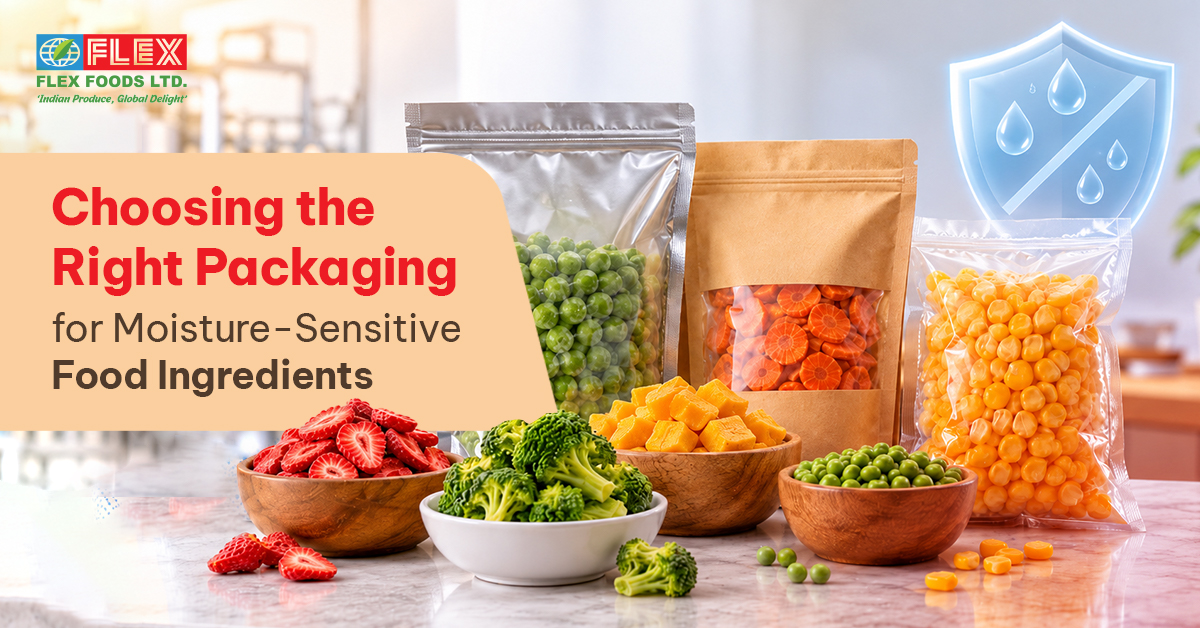
Moisture can change the quality of a food ingredient long before it reaches the consumer. A small amount of unwanted water entering a package can cause dried vegetables to lose their crispness, fruit powders to form hard lumps, herbs to lose their texture and dehydrated fruits to become sticky. In some cases, moisture exposure can also create conditions that support microbial growth and shorten shelf life.
For food manufacturers, exporters and ingredient suppliers, packaging is much more than a way to store and transport products. It is a critical part of food preservation.
This becomes particularly important for ingredients that undergo drying or dehydration. Freeze-dried fruits, dried vegetables, herbs and powdered food ingredients often have low moisture content and porous structures. While these characteristics help preserve the ingredients, they can also make This guide explores how to choose suitable packaging for moisture-sensitive food ingredients, the materials available, the factors influencing packaging decisions and the best practices manufacturers should follow.
Learn more about the are dehydrated vegetables healthy
Why Moisture Control Matters in Food Ingredient Packaging?
Moisture plays an important role in the physical, chemical and microbiological stability of food. Every ingredient has a moisture level at which it maintains its intended characteristics. When this balance changes, the product may experience several quality problems.
Consider a packet of freeze-dried fruit. Its lightweight, porous structure gives it a crisp texture. However, when exposed to humid air, the product can absorb water and lose that texture. Similarly, dried herbs may lose their characteristic appearance, while vegetable powders can become difficult to handle during processing.
Here are some common effects of moisture exposure.
Loss of Texture and Crispness
Dried ingredients often depend on low moisture levels to retain their original texture. Moisture absorption can soften crispy products, make dried fruits leathery and cause powders to clump. For food manufacturers, this affects the ingredient's suitability for its intended application. A freeze-dried fruit that should provide a crunchy texture in breakfast cereals or snack products may no longer deliver the expected experience
Microbial Growth
Low-moisture foods generally offer less favourable conditions for microbial growth than high-moisture foods. However, they are not necessarily sterile.
When a product absorbs moisture, its water activity may increase. Depending on the ingredient and storage conditions, this can create conditions that support the growth of certain microorganisms.
Packaging should therefore help maintain the product's intended moisture equilibrium while protecting it from external contamination
Changes in Colour, Flavour and Aroma
Moisture can influence several chemical and physical reactions within food ingredients. It may contribute to pigment degradation, flavour changes and undesirable texture alterations.
Dried herbs, for example, need protection from environmental conditions that can affect their colour and volatile aromatic compounds. Fruit ingredients may also experience changes in appearance and flavour when stored in unsuitable packaging.
Reduced Shelf Life
Moisture exposure can accelerate quality deterioration. Even when the product remains safe to consume, changes in texture, appearance and functionality may make it unsuitable for commercial applications.
For exporters, this can lead to customer complaints, rejected consignments and financial losses.
Know more about the thawing meaning
Understanding Moisture Sensitivity in Different Food Ingredients
Not every dried food ingredient responds to moisture in the same way. Packaging requirements depend on the product's composition, structure, processing method and intended application.
| Food ingredient | Common moisture-related concern | Packaging priority |
|---|---|---|
| Freeze-dried fruits | Loss of crispness and stickiness | High moisture barrier |
| Dried vegetables | Softening and quality deterioration | Moisture and oxygen protection |
| Vegetable powders | Caking and lump formation | Moisture-resistant, sealed packaging |
| Dried herbs | Texture and aroma deterioration | Moisture, oxygen and light protection |
| Dehydrated fruits | Stickiness and texture changes | Moisture barrier and seal integrity |
| Food seasoning blends | Clumping and uneven distribution | Moisture and contamination protection |
For instance, frozen vegetables in India and dried vegetables have different preservation requirements. Frozen products require packaging that supports frozen storage and prevents freezer-related quality problems. Dried vegetables, on the other hand, need packaging that limits moisture ingress and protects their low-moisture structure.
Similarly, freeze-dried mango requires careful moisture management because its porous structure can absorb water quickly. Suitable packaging helps preserve its characteristic crispness, colour and flavour during storage and distribution.
Understanding these differences is the first step towards selecting the right packaging material.
Key Packaging Materials for Moisture-Sensitive Food Ingredients
Food manufacturers have access to several packaging materials designed to provide moisture protection. The right choice depends on the ingredient's sensitivity, shelf-life requirements, storage environment and distribution channel.
Aluminium Foil Laminates
Aluminium foil laminates are widely used for products that require strong protection against moisture, oxygen and light.
These structures generally combine aluminium foil with polymer layers. Each layer serves a different purpose. The foil provides the primary barrier, while the polymer layers support sealing, strength and product contact requirements.
Advantages:
- Excellent moisture barrier.
- Strong protection against oxygen and light.
- Suitable for highly moisture-sensitive ingredients.
- Helps maintain product quality during extended storage.
- Available in different pouch and bag formats.
Limitations:
- Generally more expensive than basic plastic packaging.
- Not transparent, which prevents consumers from viewing the product.
- Aluminium foil can be damaged by improper folding, handling or puncturing.
Aluminium foil laminates are suitable for freeze-dried fruits, sensitive vegetable powders, dried herbs and other ingredients that require strong environmental protection.
Metallised Films
Metallised films are plastic films coated with a thin layer of metal, usually aluminium. They offer a reflective appearance and provide improved barrier properties compared with many uncoated films.
Common structures include metallised PET and metallised BOPP.
Advantages:
- Good moisture barrier.
- Improved protection against light.
- Lightweight construction.
- Suitable for flexible packaging formats.
- Often more economical than aluminium foil laminates.
Limitations:
- Barrier performance is generally lower than a well-designed aluminium foil laminate.
- The metal coating may be affected by flexing or abrasion.
- Performance varies according to film type and manufacturing quality.
Metallised packaging can work well for dried fruit pieces, snack ingredients and certain dehydrated food products where a balance between protection and cost is required
High-Barrier Polyethylene Films
Polyethylene (PE) is commonly used in food packaging because of its flexibility, moisture resistance and heat-sealing properties.
However, standard polyethylene films may not provide sufficient protection for highly sensitive products when used alone. Manufacturers can consider multilayer structures that combine PE with other barrier materials.
Advantages:
- Good moisture resistance.
- Flexible and lightweight.
- Reliable heat-sealing performance.
- Available in different thicknesses.
- Suitable for food-contact applications when appropriately manufactured.
Limitations:
- Limited oxygen barrier compared with specialised barrier structures
- Standard PE may not provide adequate protection for extremely moisture-sensitive ingredients.
- Performance depends on film composition and thickness
PE is often used as an inner sealing layer in laminated packaging rather than as the only protective material.
PET Packaging Films
Polyethylene terephthalate (PET) is a popular packaging material because of its strength, dimensional stability and clarity.
PET films are often combined with PE, aluminium foil or metallised layers to create packaging structures that provide both mechanical protection and barrier performance.
Advantages:
- Good tensile strength.
- Excellent printability.
- Suitable for laminated packaging.
- Good dimensional stability.
- Available in transparent and metallised forms.
Limitations:
- Standard PET does not provide the same moisture barrier as aluminium foil.
- It may require additional layers for highly sensitive ingredients.
PET is particularly useful when manufacturers need packaging that combines product visibility, durability and a customised printed finish.
Glass Containers
Glass offers an excellent barrier against moisture and gases when paired with an effective closure.
It is also chemically stable and does not easily interact with food ingredients. However, glass containers are heavier and more fragile than flexible packaging.
Advantages:
- Excellent moisture and gas barrier through the container body.
- Does not readily absorb flavours or odours.
- Suitable for premium food ingredients.
- Allows product visibility when transparent glass is used.
Limitations:
- Higher transportation weight.
- Risk of breakage.
- Greater storage and handling requirements.
- Closure performance determines the effectiveness of the complete package.
Glass jars may be suitable for premium dried herbs, specialty fruit ingredients and small-volume products.
Rigid Plastic Containers
Rigid plastic containers made from materials such as PET and HDPE are another packaging option. They offer structural protection and can be paired with airtight closures, induction seals or suitable liners.
Their moisture barrier performance varies depending on the plastic resin, wall thickness, design and closure system.
They are useful for ingredients that require repeated access, convenient storage or additional mechanical protection.
Read more : button mushroom
Choosing the Right Packaging Format
The packaging format is just as important as the material. Manufacturers must consider product volume, handling requirements, storage conditions and the customer's intended use.
Stand-Up Pouches
Stand-up pouches are suitable for retail-ready dried fruits, herbs and snack ingredients. They can be manufactured using multilayer barrier films and fitted with resealable zippers.
Their compact design also makes storage and transportation convenient.
However, the zipper alone should not be treated as the primary moisture barrier. The initial heat seal and the quality of the laminate remain essential.
Flat Pouches
Flat pouches are useful for smaller quantities and sample packs. They require less storage space and can be produced using high-barrier laminated films.
They are particularly suitable for powdered ingredients and portion-controlled food products.
Bulk Bags
Industrial food ingredient suppliers often use large-capacity bags to transport dried vegetables, fruit pieces and powders to food processing facilities.
These bags should provide sufficient moisture resistance, mechanical strength and sealing reliability.
Depending on the product, a high-barrier inner liner may be used inside a woven outer bag or corrugated shipping container.
Vacuum-Sealed Packaging
Vacuum packaging removes much of the air from the package before sealing. This reduces oxygen exposure and can help protect ingredients susceptible to oxidation.
However, vacuum packaging does not automatically provide a strong moisture barrier. The selected film must still have suitable WVTR properties.
It may also be unsuitable for delicate, highly porous products if the vacuum pressure crushes or damages their structure.
Nitrogen-Flushed Packaging
Nitrogen flushing replaces some of the air inside a package with nitrogen before sealing.
This can reduce residual oxygen and help preserve the quality of oxidation-sensitive ingredients
It is useful for certain dried fruits, herbs and specialty food ingredients. However, nitrogen flushing does not prevent external moisture from entering through the packaging material or defective seals.
Best Practices for Packaging Moisture-Sensitive Ingredients
Choosing the right material is only one part of the process. Packaging operations must also follow appropriate handling and storage practices.
Package Products in a Controlled Environment
Avoid leaving dried ingredients exposed to humid production environments for extended periods.
Packaging areas should have suitable temperature and humidity controls. Products should move from processing to packaging without unnecessary delays.
This is especially important for freeze-dried products because their porous structures can absorb environmental moisture.
Ensure Products Are Properly Cooled Before Packing
Ingredients should be cooled appropriately before packaging. Packing products while they are too warm can create condensation under certain conditions.
Temperature differences between the product, packaging and surrounding environment should be considered during the packing process.
Use Reliable Sealing Equipment
Heat-sealing equipment should be calibrated and maintained regularly.
Incorrect sealing temperatures, pressure or dwell times can result in weak seals. Routine checks help identify these problems before packaged products enter distribution.
Avoid Excessive Headspace
Unnecessarily large headspace can increase the amount of air and moisture present inside a package.
However, the correct headspace depends on the product and packaging format. Delicate products may need additional space to prevent crushing, while nitrogen-flushed packs may require controlled headspace conditions.
Store Finished Packages Correctly
Even high-barrier packaging needs appropriate storage conditions.
Manufacturers should:
- Store finished products in clean, dry areas.
- Keep packages away from direct sunlight.
- Avoid contact with wet floors and walls.
- Maintain suitable temperature conditions.
- Use pallets to prevent direct floor contact.
- Follow first-in, first-out (FIFO) or expiry-based inventory practices.
The packaging and storage environment should work together to protect the ingredient
How Flex Foods Supports Quality Across Food Ingredient Supply Chains?
Quality preservation begins well before an ingredient reaches its packaging line. Raw material selection, processing conditions, moisture control, handling and storage all influence the final product.
For food manufacturers, sourcing ingredients from a supplier that understands these requirements helps maintain consistency across production batches.
At Flex Foods Limited, the focus on processed food ingredients includes freeze-dried and IQF products, dried herbs and other ingredient categories used across food manufacturing applications.
Different ingredients require different preservation approaches. Freeze-dried fruit pieces, for example, need protection against moisture absorption to retain their characteristic texture. Dried herbs require careful handling to preserve their natural colour and aromatic qualities. Vegetable ingredients must retain the characteristics required for their intended food applications.
The right combination of processing, packaging and storage helps maintain ingredient quality from production to delivery.
Conclusion
Choosing the right packaging for moisture-sensitive food ingredients requires more than selecting a durable pouch or container. Manufacturers must understand how their ingredients respond to moisture, evaluate the barrier properties of different materials and consider the conditions products will encounter during storage and transportation.
Aluminium foil laminates, metallised films, multilayer plastic structures and rigid containers each offer different advantages. The ideal solution depends on the ingredient, required shelf life, distribution environment and commercial requirements
Equally important are reliable sealing practices, controlled packaging environments and regular shelf-life testing.
For food ingredient manufacturers and exporters, investing in suitable packaging is an investment in product consistency, reduced wastage and customer confidence.
When packaging works alongside the right processing and storage practices, moisture-sensitive ingredients can retain their intended quality throughout the supply chain.
Frequently Asked Questions
What is the best packaging material for moisture-sensitive food ingredients?
Aluminium foil laminates are among the strongest options for moisture-sensitive ingredients because they provide excellent water vapour, oxygen and light barriers. Metallised films and multilayer plastic laminates are alternatives depending on the product's sensitivity, shelf-life requirements and budget.
What does WVTR mean in food packaging?
WVTR stands for Water Vapour Transmission Rate. It measures how much water vapour passes through a packaging material over a specific period under defined testing conditions. A lower WVTR generally indicates better moisture barrier performance.
Why do freeze-dried foods require special packaging?
Freeze-dried foods have porous structures and low moisture content. They can absorb moisture from the surrounding environment, resulting in softening, loss of crispness and potential quality deterioration. High-barrier packaging helps maintain their original characteristics.
Are vacuum-sealed bags suitable for dried fruits?
Yes, vacuum-sealed bags can help reduce oxygen exposure and protect certain dried fruits. However, the packaging material must also provide adequate moisture resistance. Vacuum pressure should be selected carefully to avoid damaging delicate fruit pieces.
What is the difference between moisture content and water activity?
Moisture content measures the total amount of water present in a food product. Water activity measures the availability of that water for microbial and chemical activity. Both are important when determining food stability and packaging requirements.