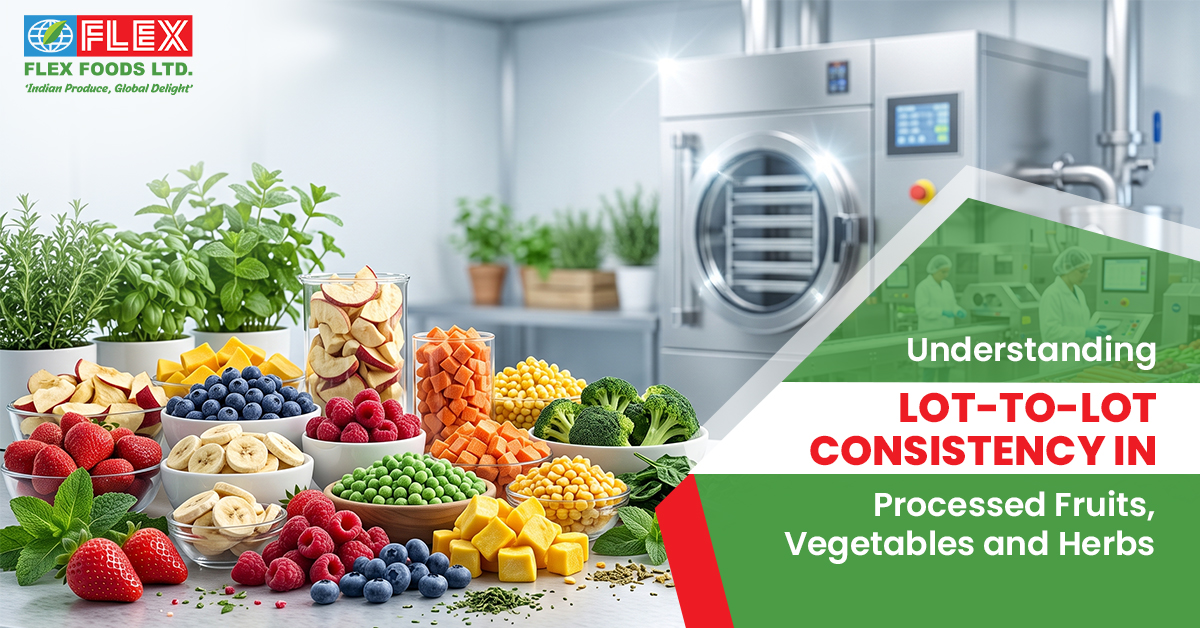
Lot-to-lot consistency refers to a food manufacturer's ability to produce successive batches that meet the same defined quality specifications. For processed fruits, vegetables, and herbs, consistency depends on raw-material selection, standardized processing, controlled storage, laboratory testing, and documented quality-assurance procedures.
Food manufacturers rely on consistent ingredients to maintain the taste, appearance, texture, and performance of their finished products. A beverage manufacturer, for example, needs fruit ingredients with predictable flavour and colour. A ready-to-eat meal producer needs vegetables that meet specified size, texture, and moisture requirements. Similarly, a seasoning manufacturer depends on herbs with consistent aroma, colour, and particle size.
A structured quality-control system helps identify variations early, reduce avoidable waste, and ensure that every released batch meets the agreed requirements.
Learn more about the parsley vs coriander
What Is Lot-to-Lot Consistency in Food Processing?
Lot-to-lot consistency in food processing means maintaining comparable quality characteristics across separate production batches. It involves defining acceptable limits for relevant parameters and verifying that each lot meets those requirements before release.
What Does Consistency Mean for Processed Fruits, Vegetables, and Herbs?
Consistency involves more than visual similarity. Manufacturers may evaluate several characteristics, including:
- Colour and overall appearance.
- Flavour and aroma.
- Moisture content and water activity.
- Texture and particle size.
- Microbiological quality.
- Foreign matter and product purity.
- Nutritional or functional properties, where relevant.
The applicable parameters depend on the ingredient and its intended use. A fruit ingredient used in a beverage may require particular attention to flavour and colour, while a dried herb intended for seasoning may require close monitoring of aroma, moisture, and microbial quality.
Lot-to-Lot Consistency vs. Product Uniformity
Product uniformity describes how similar individual pieces or portions are within one lot. Lot-to-lot consistency compares separate batches against the same specifications. Process consistency refers to the ability of manufacturing operations to remain within defined control limits.
These concepts are related but distinct. A batch may contain pieces of similar size while still differing from the previous batch in colour or moisture content.
The objective is not to eliminate every natural difference. Instead, manufacturers must keep important quality attributes within measurable limits suitable for the product and customer requirements.
Read more about the best food to freeze dry
Why Do Processed Fruits, Vegetables, and Herbs Vary Between Lots?
Batch-to-batch variation can begin in the field and continue through processing, packaging, storage, and distribution. Understanding these causes helps manufacturers develop effective controls.
1. Agricultural and Seasonal Variations
Rainfall, irrigation, temperature, sunlight, and soil composition influence how fruits, vegetables, and herbs grow. Seasonal differences can affect pigmentation, sugar content, acidity, dry matter, moisture, and aroma.
For example, fruits harvested during different growing seasons may have different sweetness levels or firmness. Herbs grown under different environmental conditions may also show variations in colour and aroma.
Manufacturers can reduce avoidable variation by working with approved suppliers, documenting sourcing requirements, and evaluating incoming raw materials against established specifications.
2. Variety and Cultivar Differences
Different varieties of the same crop may have different colours, textures, fibre content, sugar levels, and processing characteristics.
These differences matter because not every variety performs equally well in every application. Manufacturers should define acceptable varieties or establish suitable performance criteria before purchasing raw materials.
3. Harvest Maturity
Harvest maturity affects flavour, colour, firmness, and processing behaviour. Under-ripe fruits may have different sweetness and acidity from fully mature fruits. Overripe produce may be softer and more susceptible to physical damage.
Clear maturity criteria and incoming inspections help manufacturers select raw materials that suit their processing requirements.
4. Raw-Material Handling and Transportation
Delays between harvesting and processing can affect freshness and product integrity. Mechanical damage, unsuitable temperatures, excess humidity, and exposure to oxygen or light can also influence quality.
Appropriate handling procedures and suitable transport conditions help preserve raw-material characteristics before production begins.
5. Processing Conditions
Washing, sorting, cutting, blanching, drying, freezing, cooling, and packaging can influence the final product. Variations in temperature, processing time, equipment loading, and product size may lead to differences in moisture, colour, texture, and appearance.
Standard operating procedures and documented process parameters help control these variations.
6. Storage and Distribution
Finished products may change during storage if exposed to unsuitable temperatures, moisture, oxygen, or light. Damaged packaging can also compromise product stability.
Manufacturers must select appropriate packaging and storage conditions based on the ingredient's characteristics and expected distribution environment.
Key takeaway: Consistency requires quality controls across the entire supply chain, from agricultural sourcing to finished-product delivery.
How Food Manufacturers Maintain Lot-to-Lot Consistency?
A systematic quality-management approach helps manufacturers control variation before it affects finished products.
1. Standardize Raw-Material Procurement
Manufacturers should work with approved suppliers who can meet defined quality requirements. Supplier qualification should consider raw-material specifications, handling practices, traceability, and historical performance.
Seasonal sourcing plans can also help procurement teams prepare for expected variations in availability and crop characteristics.
2. Implement Incoming Quality Control
Incoming inspections help identify unsuitable materials before they enter production. Depending on the ingredient and risk assessment, checks may include identity, variety, appearance, maturity, moisture, foreign matter, microbiological criteria, and applicable contaminant requirements.
Materials that fail established acceptance criteria should be identified and managed according to documented procedures.
3. Standardize Processing Parameters
Standard operating procedures should define the appropriate conditions for cleaning, cutting, pretreatment, drying, freezing, cooling, blending, and packaging.
Manufacturers should record relevant process data and establish suitable operating ranges. This makes it easier to identify whether a quality deviation originated from raw materials, equipment, or processing conditions.
4. Use In-Process Quality Checks
Quality checks during production allow teams to identify deviations before completing an entire batch.
Depending on the process, checks may include moisture measurements, colour assessments, temperature monitoring, particle-size evaluation, visual inspections, and verification of drying or freezing endpoints.
5. Apply Batch-Wise Laboratory Testing
Representative sampling and appropriate analytical methods help manufacturers verify that finished products meet their specifications. Testing requirements should reflect product characteristics, intended use, customer expectations, and applicable regulations.
6. Maintain Equipment and Calibrate Instruments
Poorly maintained equipment can create inconsistent results. Manufacturers should inspect processing machinery, maintain temperature sensors, calibrate weighing systems, and verify the accuracy of moisture analysers and other testing instruments.
7. Establish Corrective and Preventive Actions
When a batch fails a specification, manufacturers should investigate the root cause rather than repeatedly correcting the same problem.
Documented corrective and preventive actions help teams address process weaknesses, assign responsibility, and verify whether the changes prevent recurrence.
How Processing Methods Affect Lot-to-Lot Consistency?
Different processing technologies require different controls. Manufacturers must select parameters that suit the product, equipment, and desired characteristics.
Freeze-Drying
Freeze-drying removes ice from frozen material through sublimation under controlled conditions. Freezing conditions, chamber pressure, shelf temperature, product loading, and drying endpoints can influence moisture, structure, colour, and rehydration performance.
Consistent product preparation and validated drying cycles help manufacturers achieve more predictable results.
Air-Drying and Dehydration
Air-drying uses controlled heat and airflow to remove moisture. Temperature, humidity, airflow, slice thickness, and drying time can influence colour, texture, and final moisture content.
Monitoring these parameters helps prevent under-drying and excessive drying.
IQF Processing
Individually quick-frozen processing preserves separate pieces of fruit, vegetables, or herbs. Product size, freezing conditions, equipment performance, and cold-chain management influence the consistency of the finished product.
For example, buyers sourcing IQF Mango may assess piece size, colour, ripeness, product integrity, and the presence of excessive ice or clumping. Consistent cutting, suitable freezing conditions, and temperature control help maintain the required specifications.
Thermal Processing and Blending
Thermal processing requires appropriate control of time, temperature, and cooling conditions. Blending and size reduction require attention to ingredient ratios, mixing time, and particle-size distribution.
A process that works well for one ingredient may not deliver the same results for another. Manufacturers should validate processing parameters for each product and intended application.
Lot-to-Lot Consistency in Processed Fruits, Vegetables, and Herbs
Although the principles of quality management remain similar, each product category has specific consistency requirements.
Processed Fruits
Fruit processors commonly monitor ripeness, sweetness, acidity, colour, piece size, moisture, texture, and aroma. These attributes influence how ingredients perform in beverages, bakery products, snacks, desserts, and ready-to-eat foods.
Suppliers offering freeze dried food in India must consider these parameters alongside suitable packaging, storage, and product-specific quality testing to meet buyer expectations.
Processed Vegetables
Vegetable processors focus on colour retention, cut size, texture, moisture, product integrity, and rehydration performance where applicable.
Uniform preparation and controlled processing help manufacturers produce ingredients that behave predictably during blending, cooking, and formulation.
Processed Herbs
Herbs require careful handling because aroma compounds and colour can be sensitive to processing, oxygen exposure, temperature, and storage conditions.
Quality teams may monitor aroma, colour, particle size, moisture, foreign matter, and microbiological quality. Buyers sourcing IQF Herbs may also assess leaf integrity, colour, separation between pieces, and cold-chain conditions.
Why Specifications Must Be Product-Specific
A universal specification cannot adequately represent every fruit, vegetable, and herb. Each product requires acceptance criteria suited to its natural characteristics, processing method, intended application, and customer requirements.
Common Challenges in Maintaining Lot-to-Lot Consistency
Food manufacturers may face several challenges when managing natural ingredients and complex processing operations.
Common issues include:
- Seasonal changes in raw materials.
- Variations in crop maturity and growing conditions.
- Changes in suppliers or sourcing regions.
- Inconsistent raw-material moisture.
- Uncontrolled processing conditions.
- Inadequate sampling procedures.
- Equipment calibration problems.
- Packaging defects and unsuitable storage.
- Incomplete batch records.
- Repeated quality deviations without effective root-cause analysis.
Manufacturers can address these challenges through supplier qualification, risk-based testing, standardized operating procedures, equipment maintenance, process validation, traceability, and documented corrective actions.
Know more about the Cold Chain vs Ambient Shipping
Why Lot-to-Lot Consistency Matters for Food Manufacturers and Exporters?
Consistent ingredients help food manufacturers maintain product quality while meeting customer expectations.
Consistent Product Formulation
Variations in moisture, colour, flavour, and particle size can affect finished-product formulations. Ingredients that meet defined specifications help manufacturers maintain predictable recipes and product characteristics.
Reliable Production Performance
Consistent raw materials reduce the need for repeated formulation adjustments and processing changes. This can support smoother production planning and reduce avoidable waste.
Customer Confidence and Supplier Qualification
Procurement teams need evidence that suppliers can meet agreed requirements across repeated deliveries. Clear specifications, reliable test results, traceability, and consistent quality records support supplier evaluations.
Export Quality Requirements
Food exporters must meet agreed product specifications and applicable regulations in their destination markets. Consistency helps support these requirements, although it does not by itself guarantee regulatory compliance or export acceptance.
Reduced Waste and Rework
Early detection of quality deviations allows manufacturers to investigate problems before they affect larger quantities of finished products. Effective controls can reduce rejected batches, rework, and customer complaints.
Conclusion
Lot-to-lot consistency is essential for food manufacturers that depend on reliable ingredients across repeated production runs. Natural differences in agricultural materials make some variation unavoidable, but a structured quality-management system can keep important characteristics within agreed specifications.
For food processors, ingredient buyers, and exporters, consistent quality supports predictable formulations, efficient production, reduced waste, and stronger customer relationships. By treating quality control as an ongoing process rather than a final inspection, manufacturers can build more reliable supply chains and meet the changing requirements of commercial food production.
Frequently Asked Questions
1. What Is Lot-to-Lot Consistency in Food Processing?
Lot-to-lot consistency is the ability to produce successive food batches that meet the same defined quality specifications. Manufacturers achieve it through raw-material controls, standardized processing, appropriate testing, and documented quality-assurance procedures.
2. Why Is Lot-to-Lot Consistency Important?
It helps manufacturers maintain predictable ingredient quality, reduce production variation, meet customer specifications, and support reliable product performance in commercial food applications.
3. What Causes Batch-to-Batch Variation in Processed Fruits and Vegetables?
Variation can result from differences in crop variety, growing conditions, harvest maturity, raw-material handling, processing parameters, storage, and packaging. Effective controls help keep relevant characteristics within established limits.
4. How Do Manufacturers Measure Lot-to-Lot Consistency?
Manufacturers compare batch results against predefined specifications. Depending on the product, tests may measure moisture, water activity, colour, particle size, texture, flavour, and microbiological quality.
5. What Is the Role of a COA in Lot-to-Lot Consistency?
A Certificate of Analysis records selected test results for a particular production lot. It helps buyers assess whether the ingredient meets agreed specifications when the sampling and testing methods are reliable.
6. How Can Manufacturers Reduce Batch-to-Batch Variation?
They can improve consistency through supplier qualification, incoming inspections, standardized processing, in-process monitoring, calibrated equipment, representative sampling, batch-wise testing, and root-cause analysis.
7. Does Lot-to-Lot Consistency Mean Every Batch Must Be Identical?
No. Natural ingredients have inherent biological and agricultural differences. Consistency means keeping relevant quality characteristics within measurable limits that suit the product and customer requirements.
8. How Does Processing Technology Affect Lot-to-Lot Consistency?
Processing technology influences moisture, colour, texture, particle size, and functional properties. Validated operating conditions, equipment maintenance, and product-specific testing help control variation between batches.