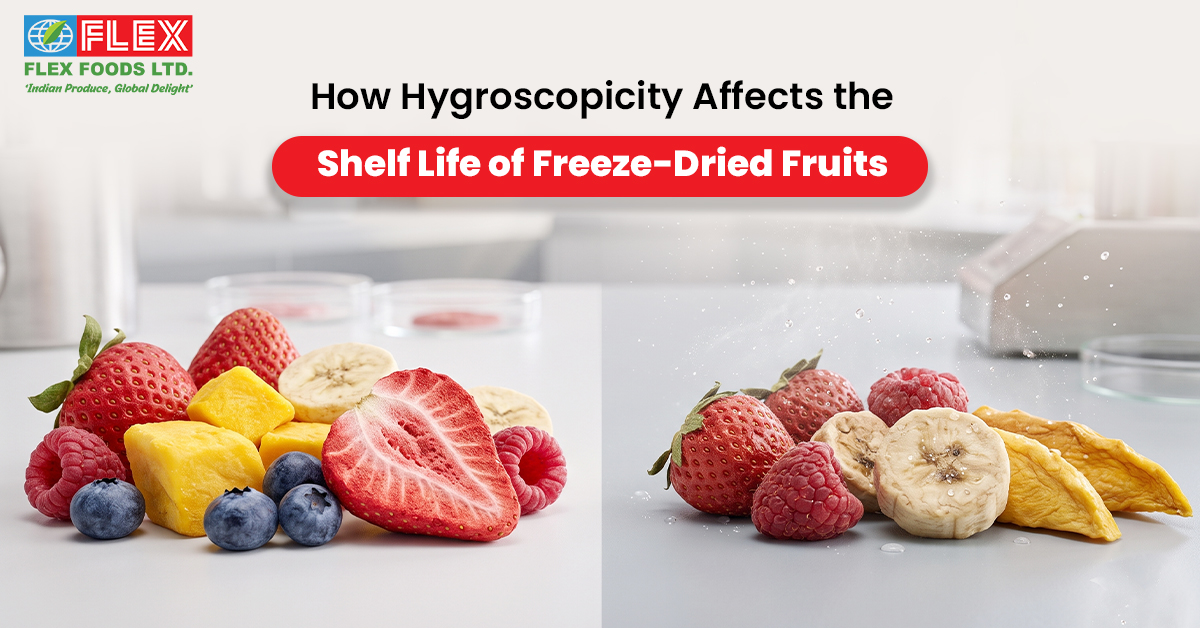
Hygroscopicity plays an important role in determining the quality, stability, and shelf life of freeze-dried fruits. It refers to the ability of a material to absorb moisture from its surrounding environment, which can affect the texture, appearance, and storage stability of dried products. Although freeze-drying removes water at low temperatures under vacuum, the resulting porous structure can make fruit pieces vulnerable to moisture absorption after processing. Understanding this behaviour helps food manufacturers select appropriate drying parameters, packaging materials, and storage conditions to preserve product quality
Excessive moisture absorption can cause freeze-dried fruits to lose their crispness, become sticky, undergo structural changes, and experience accelerated quality deterioration. These effects depend on fruit composition, environmental humidity, water activity, and the effectiveness of the packaging system. Manufacturers must therefore manage moisture exposure throughout processing, packaging, transportation, and storage. A coordinated moisture-control strategy can help maintain the characteristic texture and appearance of freeze-dried fruit ingredients throughout their intended shelf life.
Learn more about best things to freeze dry
What Is Hygroscopicity in Freeze-Dried Fruits?
Hygroscopicity describes the tendency of a material to attract and absorb water vapour from the surrounding air. When a dried fruit is exposed to an environment with a higher relative humidity than the conditions corresponding to its current moisture equilibrium, it can absorb additional moisture. The amount absorbed depends on factors such as temperature, environmental humidity, fruit composition, and physical structure. This behaviour is particularly important for products intended to retain a lightweight, porous, and crisp texture during storage.
Freeze-drying removes frozen water through sublimation, leaving behind a structure containing numerous pores where ice crystals previously existed. These pores contribute to the characteristic texture of freeze-dried fruit but can also influence how moisture interacts with the product. Naturally occurring sugars, organic acids, and other soluble compounds further affect the fruit's moisture-sorption behaviour. Consequently, different fruit varieties may respond differently to the same storage environment, making product-specific moisture management essential.
Read more about the GLOBALG.A.P. Certification
Hygroscopicity vs. Moisture Content vs. Water Activity
Hygroscopicity, moisture content, and water activity describe related but distinct aspects of food stability. Hygroscopicity indicates the tendency to absorb moisture, while moisture content measures the amount of water present in a product. Water activity indicates how available that water is for microbial growth and chemical reactions, rather than simply measuring total water content. Understanding these differences helps manufacturers assess moisture-related risks more accurately and establish suitable product specifications.
| Parameter | Meaning | Importance for Freeze-Dried Fruits |
|---|---|---|
| Hygroscopicity | Tendency to absorb moisture from the environment | Helps assess susceptibility to moisture uptake |
| Moisture content | Amount of water present in the product | Helps monitor drying performance and moisture changes |
| Water activity (aw) | Measure of water availability | Helps assess microbial and chemical stability |
| Equilibrium moisture content | Moisture content at equilibrium with a defined environment | Helps predict moisture behaviour under specific storage conditions |
These parameters should be evaluated together because low initial moisture content does not automatically guarantee long-term stability. A product may absorb moisture during distribution even when it meets its initial moisture specification. Changes in water activity can also affect quality in ways that total moisture content alone may not reveal. Establishing appropriate acceptance criteria for each parameter helps manufacturers maintain consistent product quality.
How Does Hygroscopicity Affect the Shelf Life of Freeze-Dried Fruits?
1. Loss of Crispness and Crunchiness
Crispness is one of the defining characteristics of many freeze-dried fruit products. When moisture enters the porous structure, it can act as a plasticizer, increasing the mobility of components within the food matrix and reducing brittleness. The product may gradually become softer, chewier, or less crunchy than intended. These textural changes can reduce consumer acceptance, particularly in snacks, breakfast cereals, and products where crispness is a key quality attribute.
2. Structural Collapse and Shrinkage
Moisture absorption can affect the physical structure created during freeze-drying. As water interacts with the amorphous components of the fruit, the matrix may become less rigid and more susceptible to deformation. Under suitable conditions, this can contribute to pore collapse, shrinkage, stickiness, or changes in the product's original shape. The extent of these changes depends on fruit composition, temperature, moisture uptake, and the structural characteristics established during processing.
3. Changes in Colour and Appearance
Moisture-related changes can influence the visual quality of freeze-dried fruits. Increased moisture may facilitate certain chemical reactions that contribute to browning or pigment deterioration, depending on the fruit and storage environment. Sticky surfaces, deformation, and loss of structural integrity can also make the product appear less appealing. Monitoring colour alongside moisture content and water activity helps manufacturers identify changes before they significantly affect commercial quality.
4. Flavour and Aroma Deterioration
Moisture exposure can interact with other processes that affect the flavour and aroma of dried fruits. Changes in the food matrix may influence the retention and release of volatile compounds, while suitable moisture and temperature conditions can accelerate certain chemical reactions. These changes may gradually alter the product's characteristic fruity aroma or flavour profile. Appropriate packaging and controlled storage help reduce exposure to environmental conditions that can compromise sensory quality.
5. Increased Risk of Chemical and Microbial Deterioration
Increasing moisture content can alter water activity and accelerate certain degradation reactions. If water activity reaches a level that permits growth, microorganisms may also become a concern, depending on the product, storage temperature, and contamination conditions. However, moisture absorption does not automatically mean that microbial spoilage will occur, because the actual risk depends on several interacting factors. Manufacturers should establish product-specific safety and quality criteria rather than relying on moisture content alone.
6. Reduced Commercial Shelf Life
The combined effects of texture loss, colour changes, flavour deterioration, and structural instability can reduce the period during which a product meets its quality specifications. These changes may lead to customer complaints, rejected batches, increased waste, or reduced suitability for sensitive food applications. The rate of deterioration depends on the fruit, processing method, packaging performance, and storage environment. Controlling moisture absorption is therefore an important part of maintaining commercial consistency and protecting product value.
Recommended Read : Food Recall and Crisis Management
Key Factors That Influence the Hygroscopicity of Freeze-Dried Fruits
1. Fruit Variety and Natural Sugar Composition
Different fruits have distinct sugar profiles, acid concentrations, cellular structures, and soluble-solid compositions. These differences influence their interactions with water vapour and their responses to changing humidity. Two fruits processed under similar conditions may therefore exhibit different moisture-absorption patterns. Manufacturers should evaluate each fruit type independently when establishing drying specifications and packaging requirements.
2. Freezing Conditions Before Freeze-Drying
Freezing influences the formation and distribution of ice crystals within the fruit tissue. These crystals create the pore structure left behind after sublimation, affecting physical characteristics that may influence moisture transfer. Freezing rate and temperature can therefore contribute to differences in the final product's structure. Their effects should be assessed alongside other processing variables rather than assuming that one freezing condition is ideal for every fruit.
3. Freeze-Drying Parameters
Primary drying removes ice through sublimation, while secondary drying reduces the remaining moisture in the product. Shelf temperature, chamber pressure, product thickness, and equipment performance influence the drying process and its consistency. Final moisture content and water activity provide useful indicators of whether the product meets its intended specifications. Manufacturers should validate these parameters for each product and equipment configuration instead of applying a universal drying cycle.
4. Product Porosity and Physical Structure
The porous structure of freeze-dried fruits contributes to their characteristic lightness and crispness. Pore size, distribution, surface area, and structural integrity can influence how water vapour interacts with the material. Changes in structure during processing may consequently affect both moisture uptake and subsequent textural stability. Evaluating the relationship between product structure and moisture behaviour can help manufacturers identify opportunities for process improvement.
5. Handling After Drying
Freeze-dried fruit can begin absorbing moisture as soon as it is exposed to a humid environment. Delays between the end of drying and final packaging increase the opportunity for moisture uptake. Packaging-room humidity, cooling procedures, handling practices, and the time spent in open containers can all affect the product's condition. Minimising exposure and maintaining suitable environmental controls help preserve the quality achieved during drying.
6. Packaging Material and Seal Integrity
Packaging is the main protective barrier between a dried fruit product and environmental moisture during storage. Its performance depends on the material's water vapour transmission rate, package construction, closure design, and seal integrity. Even a high-barrier material may offer inadequate protection if the finished package contains leaks or defects. Manufacturers should therefore evaluate the complete packaging system under representative storage and distribution conditions.
Read more : Role of Traceability
How to Reduce Hygroscopicity and Extend Shelf Life?
1. Optimise Freeze-Drying Conditions
Consistent drying helps manufacturers achieve repeatable moisture specifications across production batches. Process validation should consider primary drying, secondary drying, product temperature, chamber pressure, and variation in product thickness. Final moisture content and water activity should be measured against established acceptance criteria. These controls reduce variability but should be combined with suitable packaging because a properly dried product can still absorb moisture after processing.
2. Monitor Moisture Content and Water Activity
Routine moisture-content testing helps confirm that drying performance meets product requirements. Water activity testing provides complementary information about the availability of water and its relationship to stability. Measuring both parameters during production and storage can help identify changes that may not be apparent through visual inspection. Acceptance limits should be based on product-specific testing, intended applications, and relevant safety requirements.
3. Use High Moisture-Barrier Packaging
Moisture-barrier packaging helps prevent water vapour from entering the product during storage and distribution. Suitable options may include multilayer flexible pouches, foil-laminate structures, and moisture-resistant containers with appropriately designed closures. Selection should account for water vapour transmission rate, package size, storage duration, handling requirements, and transportation conditions. Packaging performance must be evaluated as a complete system rather than inferred from the material description alone.
4. Evaluate Desiccants Where Appropriate
Food-compatible desiccants can help manage residual moisture inside certain sealed packages. Their effectiveness depends on the initial moisture conditions, package permeability, product characteristics, and the desiccant's capacity. Desiccants must be suitable for the application, correctly sized, and safely contained to prevent direct contact with the food where required. They should complement, rather than replace, appropriate drying, sealing, and moisture-barrier packaging.
5. Maintain Controlled Storage Conditions
Cool, dry storage helps limit moisture exposure and can reduce the rate of some quality-degradation reactions. Warehouses should be managed to avoid excessive humidity, direct sunlight, and unnecessary temperature fluctuations. Products should remain sealed until they are required for use, and opened packages should be handled according to suitable storage procedures. Appropriate stock rotation and periodic quality checks further support product consistency throughout distribution.
6. Minimise Exposure During Packaging and Handling
Moving the product efficiently from drying to packaging reduces the period during which it is exposed to ambient humidity. Packaging areas should maintain appropriate environmental conditions for the product's moisture sensitivity. Handling procedures should minimise unnecessary transfers, prolonged exposure, and repeated opening of containers. These operational measures can help protect the product before its primary packaging barrier is established.
7. Conduct Shelf-Life Testing
Real-time stability studies help establish how a product performs under its intended storage conditions. Accelerated studies may also be useful when the testing design is scientifically justified, although they cannot always predict every change occurring during normal storage. Evaluations should include relevant measurements such as moisture content, water activity, texture, colour, flavour, and packaging integrity. Shelf-life claims should be supported by product-specific evidence rather than estimates based solely on the drying method or packaging type.
Best Packaging Solutions for Preventing Moisture Absorption
Comparing Packaging Options
Selecting suitable packaging is essential for protecting moisture-sensitive fruit ingredients. The water vapour transmission rate, or WVTR, indicates how readily water vapour passes through a packaging material under specified test conditions. Lower transmission rates generally indicate a stronger moisture barrier when materials are compared under equivalent conditions. Actual protection also depends on seals, closures, package geometry, and the environment in which the product is stored.
| Packaging Type | Potential Advantage | Key Consideration |
|---|---|---|
| Multilayer barrier pouches | Can provide strong moisture protection | Material construction and seal performance must be evaluated |
| Foil-laminate packaging | Can provide effective moisture and light protection | Requires appropriate sealing and package integrity |
| Rigid containers with sealed closures | Can provide physical protection and moisture resistance | Container and closure performance must be validated |
| Desiccant-assisted packaging | Can help manage moisture inside the sealed package | Requires appropriate desiccant selection, sizing, and containment |
Choosing Packaging for Different Applications
Packaging requirements depend on the fruit's composition, moisture sensitivity, intended shelf life, and distribution environment. Exported products may encounter longer transportation periods and wider temperature or humidity variations than products distributed locally. Package size, frequency of opening, and the intended use of the ingredient should also inform the selection process. Conducting stability trials with the final package helps verify whether the chosen system provides adequate protection.
How to Test Hygroscopicity and Predict Shelf Life?
Moisture Sorption and Laboratory Testing
Controlled moisture-sorption testing can determine how a product responds to defined temperature and relative humidity conditions. The resulting data help establish equilibrium moisture content and identify conditions associated with undesirable changes. Moisture content and water activity measurements provide additional information about the product's condition during storage. Combining these measurements with texture and colour evaluations helps researchers build a more complete picture of stability.
Real-Time and Accelerated Stability Studies
Real-time studies monitor product quality under the storage conditions for which the product is intended. Accelerated studies expose samples to selected conditions that may help reveal potential deterioration pathways over a shorter period. However, accelerated results must be interpreted carefully because changes under extreme conditions may not follow the same pattern as changes during normal storage. Product-specific evidence is necessary before translating test results into commercial shelf-life claims.
Developing a Product-Specific Shelf-Life Model
Shelf-life models can help estimate when a product may no longer meet its established quality specifications. Researchers may use changes in moisture content, water activity, texture, colour, and other relevant parameters to evaluate product deterioration. A 2025 study of restructured jujube compared different shelf-life prediction approaches and reported that its moisture-content-based model performed best among the models assessed. This finding illustrates the value of experimental data, but the model should not be transferred directly to unrelated fruit products without validation.
Industrial Applications of Moisture-Stable Freeze-Dried Fruits
Moisture stability is important in industrial applications where texture, appearance, and ingredient performance influence the quality of the finished product. In bakery applications, manufacturers need ingredients that remain stable during storage and handling before incorporation into formulations. Breakfast cereals and snack products often depend on crisp fruit pieces, making moisture control important for maintaining the expected eating experience. Appropriate packaging and storage can help protect the ingredient before it reaches the food-processing line.
In dairy products, desserts, and ready-to-eat foods, moisture migration between ingredients can change texture after formulation. The behaviour of fruit inside a finished product may differ from its behaviour inside a sealed package because the surrounding food matrix creates a different moisture environment. Buyers should therefore evaluate ingredient specifications alongside the requirements of the final application. Working with experienced suppliers and establishing clear quality criteria can support more consistent product development and manufacturing.
For businesses sourcing freeze-dried fruits, important considerations include moisture specifications, water activity, packaging performance, and evidence of storage stability. Similar quality-control principles apply when evaluating freeze-dried food manufacturers in India, particularly for ingredients intended for industrial processing and distribution. Even products such as dehydrated parsley require packaging and storage practices suited to their specific moisture sensitivity and intended application. Although different dried ingredients have different compositions and quality requirements, moisture management remains an important consideration across the wider dried-food supply chain.
Conclusion
Hygroscopicity is an important factor in the long-term stability of freeze-dried fruits because moisture absorption can change texture, appearance, and overall product quality. Understanding moisture sorption, water activity, and glass transition helps manufacturers identify the conditions that contribute to deterioration. Appropriate drying, moisture-barrier packaging, controlled storage, and systematic shelf-life testing provide a practical foundation for managing these risks. By applying product-specific controls throughout processing and distribution, manufacturers can work towards consistent quality and reliable performance in industrial food applications.
Frequently Asked Questions
1. What Is Hygroscopicity in Freeze-Dried Fruits?
Hygroscopicity is the ability of freeze-dried fruits to absorb moisture from their surrounding environment. The extent of moisture uptake depends on fruit composition, temperature, relative humidity, and physical structure. Understanding this behaviour helps manufacturers develop suitable drying, packaging, and storage procedures.
2. How Does Hygroscopicity Affect the Shelf Life of Freeze-Dried Fruits?
Excessive moisture absorption can reduce crispness, change texture and appearance, and accelerate certain quality-degradation reactions. The overall effect depends on water activity, storage conditions, packaging performance, and fruit composition. Effective moisture control helps preserve product quality throughout its intended shelf life.
3. Why Do Freeze-Dried Fruits Absorb Moisture?
Freeze-dried fruits have porous structures and contain naturally occurring compounds that interact with water. When exposed to suitable humidity conditions, they can absorb water vapour from the surrounding air. This is why prompt packaging and appropriate environmental controls are important after drying.
4. How Can Moisture Absorption Be Prevented?
Moisture absorption can be reduced through validated drying, rapid transfer to suitable moisture-barrier packaging, effective sealing, and controlled storage. Limiting exposure to humid air during handling also helps protect product quality. The most effective approach depends on the fruit and the conditions encountered during distribution.
5. What Is the Role of Water Activity in Freeze-Dried Fruit Shelf Life?
Water activity indicates how available water is for microbial growth and chemical reactions. It complements moisture-content measurements by providing information about water availability rather than total water alone. Monitoring both parameters helps manufacturers assess product stability and establish suitable quality specifications.